Colour Blindness and the Lorry Driving Licence: What Are the Rules?

For a car licence, a red-green colour vision weakness is usually no barrier. For a lorry licence, the rules are different. A professional driver carries heavy loads, drives long hours, and reads coloured signals in all weathers, and the licensing authority asks for a closer look at colour vision before it issues the licence. That is why the same person can pass the eye test for a car and still face questions about colour blindness and the lorry driving licence.
This guide explains the rules: which classes are affected, how strictly colour vision is tested for lorries and buses, what a mild weakness means in practice, and what happens when the deficiency is strong. It also explains the difference between the screening at the optician and the full examination by an eye doctor, and what to do if you already know you are colour blind and want to drive professionally.
Colour Blindness and the Lorry Licence: The Basics
Colour blindness is a difference in the way the eye sees colour, most often a difficulty in telling red from green. It affects about one in twelve men and about one in two hundred women, and it is usually inherited. It is not a disease, and it does not get worse with age. It simply means that certain colours look similar to each other, especially in dim light or when the colours are close together. Most colour blind people drive cars without any difficulty, because traffic lights are read by position as well as by colour, and road signs use shapes and words too.
For a lorry licence, the question is not whether you can see colours in everyday life, but whether an eye doctor can confirm that your colour vision is good enough for professional driving. The standard is set in the driving licence regulation, the Fahrerlaubnis-Verordnung, and it says that a driver in the professional groups must have adequate colour vision. Adequate is a flexible word, and the decision is made by the eye doctor, not by an automatic pass or fail.
The groups affected are classes C, CE, C1, C1E, D, DE, D1 and D1E, the lorry and bus classes. For a car or motorcycle licence, the colour vision screening is a short check at the optician, and a weakness rarely blocks the licence. For the professional classes, the colour vision check is part of the fuller eye examination by an ophthalmologist, and the result is taken more seriously.
The Rules for Class C and C1
For class C and C1, a mild red-green weakness usually does not block the licence. The eye doctor will test your colour vision with more plates than the optician uses, and may use a lantern test, in which small coloured lights are shown and you have to name them, or an anomaloscope, a machine that asks you to mix red and green light to match a yellow light. If you can read signals correctly in those tests, your colour vision is judged adequate, and the licence is issued.
A strong red-green deficiency can be a different matter. If you cannot tell red from green in the lantern test, or if the anomaloscope shows a large difference, the eye doctor will note it in the report, and the licensing authority can ask for a further test or a restriction. In some cases the authority accepts the licence but adds a condition. In rare cases, a very strong deficiency can lead to a refusal for the professional class. The decision depends on the size of the problem and on the doctor report, and there is no automatic rule that says all colour blind people are refused.
If you already hold a car licence and you know that you have a colour weakness, do not let it stop you from applying for a lorry licence. Arrange the eye examination first, before you pay for the course, and find out whether your colour vision is judged adequate. It is better to know before you start than to find out halfway through an expensive training course.
The Rules for Class D and D1: Buses
For bus licences, classes D and D1, the rules are stricter than for lorries, because a bus driver carries passengers and must read signals, signs and dashboard warnings quickly and reliably. The colour vision requirement is the same on paper, adequate colour vision, but in practice the eye doctor is more careful, and the licensing authority weighs a strong deficiency more heavily for a bus than for a lorry.
A mild red-green weakness can still be accepted for a bus licence if the fuller tests show that you can read coloured signals correctly. A strong deficiency, however, is more likely to lead to a refusal for class D than for class C. If you are planning to drive buses, ask the eye doctor about this before you start the training, and bring any earlier test results with you, so that the doctor has the full picture.
Our guide to the eye test for bus drivers, class D explains the full bus examination, and our article on the eye test for the lorry driving licence, class C covers the lorry rules in detail. Both classes need the same kind of eye examination, but the bus licence is the one where colour vision is weighed most carefully.
How Colour Vision Is Tested for Professional Licences
The colour vision test for a professional licence starts where the car test ends. The optician screening with a few Ishihara plates is only the first step. The eye doctor then carries out a fuller test, using the full book of plates, a lantern test or an anomaloscope, or a combination of all three. The lantern test shows small lights in red, green and white, and you have to name each one correctly. The anomaloscope asks you to turn a control until a mixture of red and green light looks the same as a yellow light. The amount of red or green you need tells the doctor how far your colour vision differs from normal.
The tests are done in good light, and they are repeated if the result is unclear. A mild weakness may show only on one test, while the others are passed. The doctor takes the whole picture into account, not a single bad answer. If you are nervous on the day, tell the doctor, and ask for a break between tests. A tired eye can make colours look duller, and the doctor would rather have a rested result than a rushed one.
Our guide to Ishihara plates and the colour vision test explains the plate method in detail, and our general article on red-green colour blindness and the driving licence covers the car rules, so that you can compare the professional tests with the standard ones.
Degrees of Colour Blindness: What Matters
Colour blindness is not one condition. It ranges from a mild weakness, where red and green look similar only in dim light or when the colours are close together, to a strong deficiency, where the two colours are hard to tell apart even in bright light. There are also different types: protanopia, where the red cones are missing or weak, and deuteranopia, where the green cones are missing or weak. The type and the degree both matter for the doctor report.
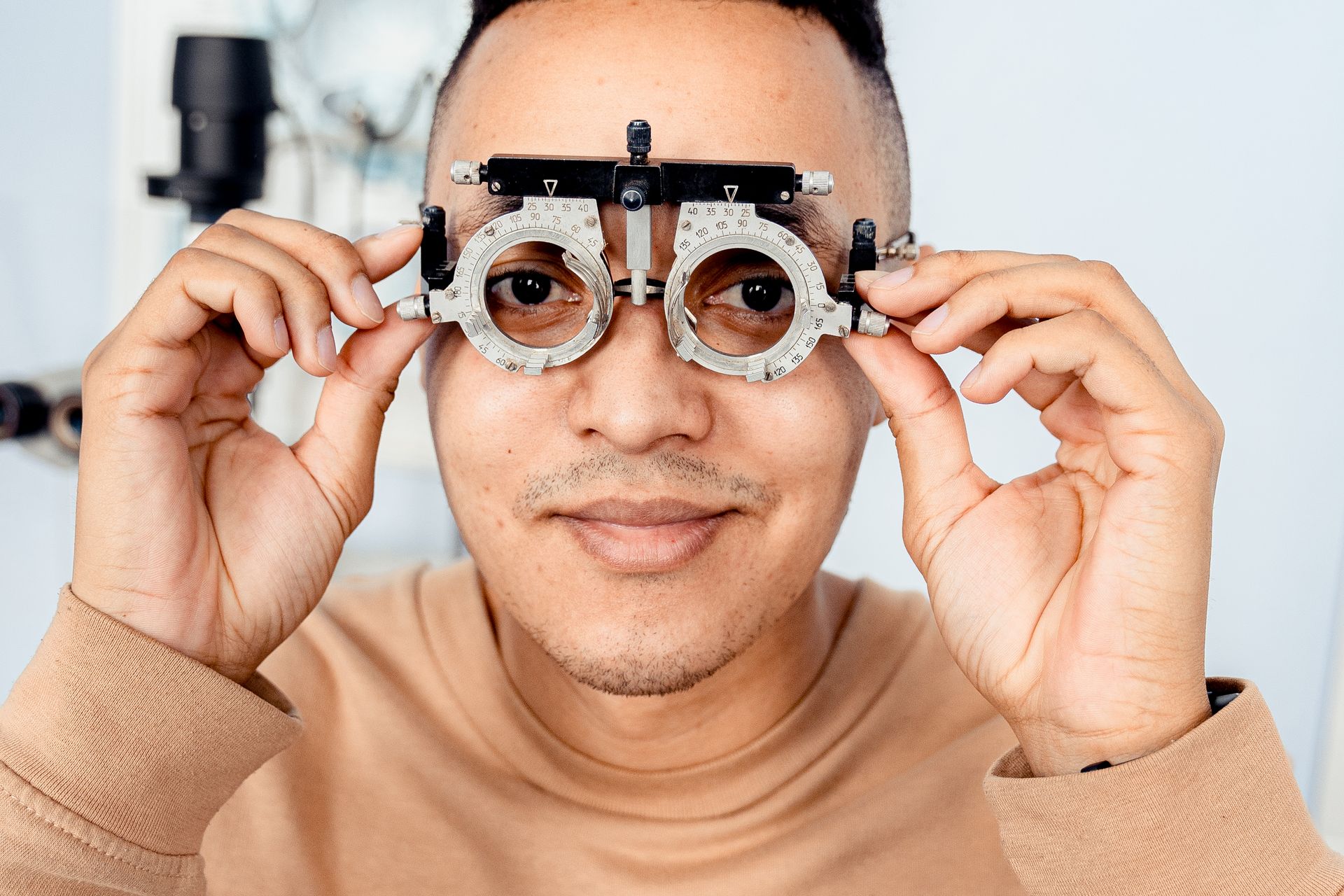
A mild deuteranomaly, the most common form, is often accepted for a lorry licence without any restriction, because the driver can still read traffic lights and signals correctly. A strong protanopia, where red looks dark, can be more of a problem, because a red traffic light can look dimmer than it should, and a red warning light on the dashboard can be harder to see. The doctor will test which type you have and how strong it is, and the report will reflect that.
It is worth knowing your type and degree before you apply. If you have old test results from an eye doctor, bring them with you. If you have never had a full test, ask for one before you start the course. Knowing the answer early saves time and money later.
When a Restriction or Refusal Applies
A restriction is a condition added to the licence, and it is the usual outcome when the colour vision result is borderline. For a lorry licence, a restriction might limit you to daylight driving, or to vehicles without certain kinds of coloured signals. The authority decides the wording, based on the doctor report, and the restriction is printed on the licence. It is not a punishment. It is a condition that lets you drive safely within the limits of your vision.
A refusal is rare, and it usually applies only when the deficiency is strong and the doctor cannot confirm that you can read signals reliably. If the authority refuses the professional class, your car licence is usually unaffected, because the car standard is lower. You can still drive a car, and you can still apply for a lorry licence again later, if your vision changes or if a new test shows a better result.
If you disagree with a decision, you can ask for a second opinion from another eye doctor, and you can ask the authority to explain the decision in writing. Decisions are made on the doctor report, not on a guess, so a second test that shows a better result can change the outcome.
What to Do If You Are Colour Blind and Want a Lorry Licence
The practical steps are simple, and the order matters. First, find out your type and degree of colour vision with a full eye examination, before you pay for any training. Second, ask the eye doctor directly whether your colour vision would be judged adequate for the class you want. Third, if the answer is yes, start the course with confidence. If the answer is no, ask which class would be possible, because a C1 licence may still be an option when a class D licence is not.
Bring all your documents to the examination: your identity card, your current licence, any earlier eye test results, and your glasses or contact lenses. Tell the doctor about any eye condition you have, and about any medicines you take. The more the doctor knows, the fairer the report.
Do not try to learn the plates or the lantern test in advance. The tests use colours you have not seen, and the result depends on your colour vision, not on your memory. The best preparation is an honest test, a good night sleep, and a clear question to the doctor about what your result means.
Practical Tips for Colour Blind Professional Drivers
Many colour blind lorry drivers work safely for decades. The trick is to use the information that does not depend on colour: the position of traffic lights, the shape of road signs, and the pattern of dashboard warning lights. A red traffic light is always at the top, a green light at the bottom, and the same position rule applies in every country, so you can read the signal without reading its colour.
Tell your employer and your colleagues if you are colour blind. It is not a secret to hide. A dispatcher who knows will not ask you to sort loads by colour, and a colleague will double check a coloured label if you ask. Most employers are used to it, and the law protects you from being treated unfairly for a condition that does not affect your driving.
In the cab, learn the dashboard by position and by symbol, not by colour. Warning lights use symbols as well as colours, and the most important ones are also shown as words or icons. If a dashboard light uses colour alone, ask the manufacturer or a colleague what it means, so that you know it by its place on the dashboard. The more you know by position, the less you need to rely on colour at all.
Conclusion
Colour blindness and the lorry driving licence do not automatically clash. A mild red-green weakness is often accepted for classes C and C1, and sometimes for class D as well, once the eye doctor has carried out the full tests. A strong deficiency can lead to a restriction, or rarely to a refusal, and the decision depends on the type and degree of the weakness and on the doctor report. The best step is to get a full eye examination before you start the course, so that you know where you stand, and to ask the eye doctor what your result means for the class you want.
Frequently Asked Questions
Can I get a lorry licence if I am colour blind?
Often yes. A mild red-green weakness is usually accepted for class C and C1 once the eye doctor has carried out the full tests. The decision depends on the type and degree of the deficiency, not on the label alone.
Is the colour test stricter for bus drivers than for lorry drivers?
Yes, in practice. Bus drivers carry passengers, so the eye doctor and the licensing authority weigh a strong deficiency more heavily for classes D and D1 than for classes C and C1. A mild weakness can still be accepted for a bus licence if the full tests are passed.
What tests are used for professional licences?
The eye doctor uses the full book of Ishihara plates, a lantern test with small coloured lights, and sometimes an anomaloscope, which asks you to mix red and green light to match a yellow light. Together, they show the type and degree of your colour vision.
Does colour blindness affect my car licence?
Usually not. A red-green weakness rarely blocks a car licence, because traffic lights are read by position as well as by colour. If a professional licence is refused, your car licence is usually unaffected.
What is a restriction on a lorry licence?
A restriction is a condition added to the licence, such as daylight driving only. It is the usual outcome when the colour vision result is borderline, and it lets you drive safely within the limits of your vision.
Should I get tested before I start a lorry driving course?
Yes. Arrange a full eye examination first and ask the eye doctor whether your colour vision would be judged adequate. It is much cheaper to find out before the course than halfway through it.