Can You Take the Eye Test at a Driving School?

If you are about to apply for a German driving licence, one of the first questions you will hear is where to take the mandatory eye test. Many learners assume the simplest answer is to take the eye test at driving school, since the school already handles the theory course, the practical lessons and most of the paperwork. It sounds efficient: one visit, one building, one appointment. In reality, the answer is more complicated, and it depends on the kind of driving school you have signed up with and the partnerships it has in your town.
This guide explains whether you can take the eye test at driving school in Germany, why most driving schools do not offer the test themselves, and what your school can still do to make the process easier. You will also learn where the test is actually done, what it costs, what to bring, and how the certificate reaches the licensing authority. By the end, you will know exactly which step belongs to the school and which step belongs to the optician or the eye doctor, so you can plan your first weeks as a learner without losing time.
The Short Answer: You Cannot Take the Eye Test at Driving School Itself
Strictly speaking, the answer is no. A driving school is not one of the officially recognised bodies that may carry out the eye test for a German driving licence. The test, known in German as the Sehtest, must be performed by an optician, an ophthalmologist, an occupational physician, or another body recognised under German law, such as a testing organisation. The result is recorded on an official certificate, the Sehtestbescheinigung, which the licensing authority accepts as proof that your eyesight meets the legal minimum for driving.
That rule exists for a clear reason. The eye test is a medical check, not a driving lesson, and it has to be carried out with standardised charts, a defined testing distance and trained staff. Driving instructors are experts in traffic rules and practical driving, but they are not trained to measure visual acuity, check your visual field or screen your colour vision. The law therefore separates the two roles: the school teaches you to drive, while a qualified tester measures your eyesight.
There is one important exception to the strict answer, and it is the reason this question causes so much confusion. Some larger driving schools cooperate with an optician who visits the school on set days, or they have an optician practice in the same building. In that case, you can sit the test in the school building, but the test is still carried out by the optician, not by the driving school. The certificate is issued by the optician, and the school simply provides the room and the appointment. If your school offers this, it is a convenient arrangement, but legally it is still an optician eye test.
Why Driving Schools Do Not Test Your Eyes Themselves
The driving licence eye test checks whether your corrected or uncorrected vision reaches a visual acuity of at least 0.7 when both eyes are tested together, for a standard car licence. The tester also checks that your visual field is wide enough and that your colour vision is sufficient to recognise traffic lights and road signs. These checks follow fixed procedures and fixed pass marks, so that a result in Munich means the same thing as a result in Hamburg. Only recognised testers are allowed to certify that the procedure was followed correctly.
For a driving school, offering the test itself would also create a conflict of interest. The school earns money when you pass your licence quickly, and it would be in its interest for every learner to pass the eye test on the first try. Keeping the test independent protects learners as well as other road users. If a school could certify its own pupils, a learner with poor eyesight might be waved through, and the problem would only surface later, perhaps in a dangerous situation on the road.
The separation is also practical. Most driving schools are small businesses with a classroom, a few cars and an office. They do not have an examination room with a standardised eye chart at the correct distance, a trial frame, or the lighting conditions an optician uses. Opticians, by contrast, carry out eye tests every day and have the equipment ready. It makes sense for each business to do what it is set up to do, and for the learner to visit both in the right order.
What Driving Schools Actually Do for Your Eye Test
Even though your school cannot test your eyes, it can do a great deal to make the eye test easy. Most schools explain the eye test on the first day, tell you that you need the certificate before you can apply for the licence, and give you the name of a nearby optician. Many schools hand out a list of opticians in the area, and some even phone the optician for you to arrange a time that fits around your lessons. That kind of help is normal, and you should ask for it if the school does not offer it on its own.
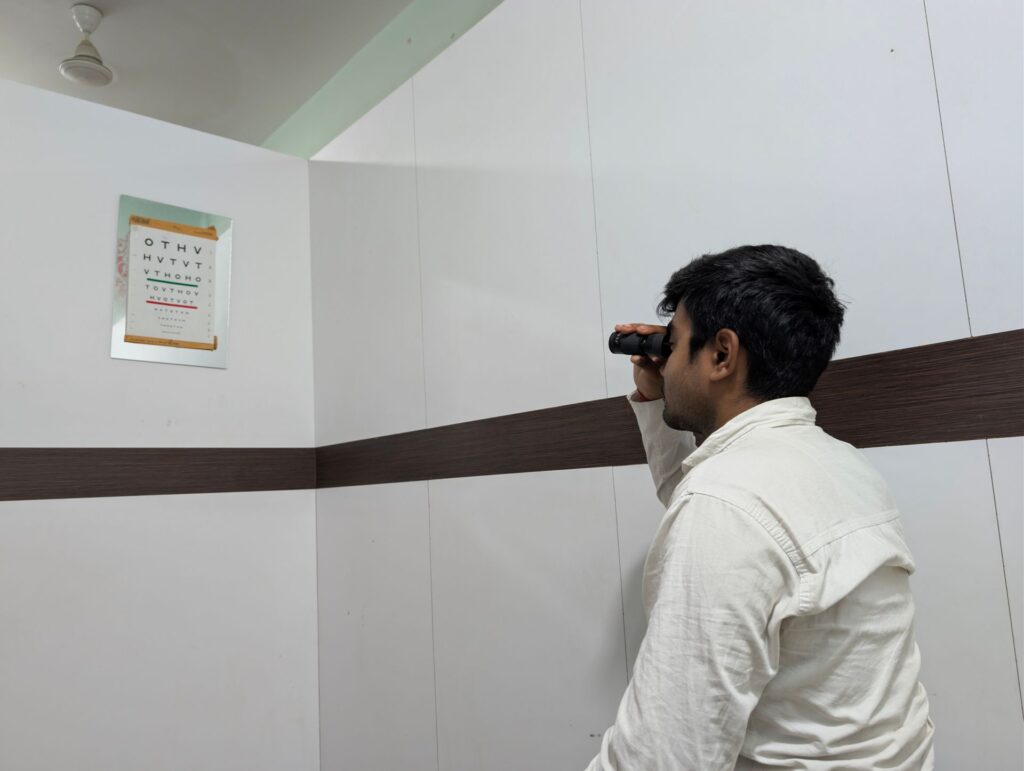
Some schools go further and organise a regular eye test day. An optician comes to the school once a week or once a month, sets up in a quiet room, and tests several learners in a row. This is popular with learners because it saves a separate trip, and it is popular with schools because the group of new learners all gets their certificates quickly. If your school offers an eye test day, the test itself is identical to the one you would get in the optician shop: the same chart, the same distance, the same certificate.
Your school may also collect your certificate and include it in your licence application, or it may ask you to bring the original yourself. Ask clearly which of these applies, and keep a copy or a photo of your certificate for your own records. The certificate is valid for two years, so a test taken at the start of your training normally stays valid until your practical test, even if your training takes several months. If your training runs longer than two years, however, you will need a new test, and your school should remind you before that deadline passes.
Where to Get the Eye Test Instead
The most common place for the driving licence eye test in Germany is an optician shop. Almost every optician, from small family businesses to large chains, offers the official Sehtest, and most do it without an appointment. You simply walk in with your identity card or passport, and the test takes around ten to fifteen minutes. The price is usually 6.43 euros, which is the standard fee many opticians charge, although some chains offer the test free of charge as a service for learners.
An ophthalmologist can also carry out the test, and this is the right choice if you know you have an eye condition, if you have had eye surgery, or if an optician has already found a problem. The eye doctor can look deeper than the standard test, check the health of your eyes, and write a more detailed report if the licensing authority asks for one. An appointment is usually needed, and the cost can be higher, so most healthy learners start with the optician.
Testing organisations and occupational health services are a third option, and they are useful if you need several certificates at once, for example for a lorry licence and a job medical. Your driving school can tell you which options exist in your area, and our procedure guide explains the whole process step by step. You can read more in our guide to the driving licence eye test procedure, which also covers what happens if you do not pass on the first attempt.
What to Bring to the Eye Test
Bring an official photo identity document, such as your identity card or passport. The tester has to record your name and date of birth on the certificate, and the document proves that the certificate belongs to you. If you already wear glasses or contact lenses, bring them and wear them as normal, because the test is taken with the correction you use for driving. If you arrive without them, the result may not reflect how you actually see on the road.
It is also worth bringing your current glasses prescription if you have one, and telling the tester about any eye condition or recent surgery. You do not need a referral from a doctor and you do not need to bring anything from your driving school, unless your school has given you a form to take with you. Some schools give learners a voucher or a small form, but most just send you to the optician with your identity document.
Come to the test rested if you can. Tired eyes, a sleepless night or a long day in front of a screen can all make you read one line less on the chart. That does not mean you should cancel for minor tiredness, but it is sensible to choose a time of day when you normally feel alert, and to avoid booking the test straight after a night shift. If you wear contact lenses, check whether the tester wants you to keep them in, which is the normal case for the driving licence test.
How Much the Eye Test Costs and How Long It Takes
At an optician, the official driving licence eye test usually costs 6.43 euros. This is the fee that many opticians charge, and it is the figure most learners in Germany pay, although a few large chains offer the test free of charge. At an ophthalmologist, the cost can be higher and is usually billed as a private service, so it is worth asking the price when you book. Testing organisations usually charge an amount similar to the optician fee.
The test itself takes around ten to fifteen minutes. You will be asked to read rows of letters or Landolt rings from a chart at a fixed distance, first with both eyes together, then with each eye separately. The tester will note the smallest line you can read reliably, and will also check your visual field and your colour vision with a short screening. You get the result immediately, and the certificate is usually issued on the spot, so you can take it straight to your driving school or keep it for your licence application.
There are no hidden extras at an optician for the standard test. If the optician finds that your vision would improve with glasses, he may offer you a full eye examination or new glasses, but that is a separate service and you are free to say no. The certificate is yours to take, and you can use it at any licensing authority, even if you later change driving schools. Keep it safe, because a replacement can take a few days and may cost a small fee.
What Happens After You Pass
Once you have the certificate, give it to your driving school or keep it for your application at the licensing authority, the Fahrerlaubnisbehörde. Together with your first aid course certificate, a passport photo and your identity document, it forms the set of documents needed to apply for the driving licence. Your school usually checks the documents before sending them, and it will tell you if anything is missing.
If you passed with glasses or contact lenses, a note is often made on your licence. In most cases, that note is the code 01.01 for glasses or 01.02 for contact lenses, and it means you must wear that correction whenever you drive. The same rule applies if you later move to another category, although lorry and bus licences have stricter vision rules and need a more detailed examination. For a standard car licence, the eye test certificate is the piece of paper that proves you meet the vision rules.
If you did not pass, do not panic. It usually means you need glasses or stronger glasses, not that you cannot drive. The optician can measure your exact prescription, you order glasses, and then you repeat the test with the new glasses. Our guide for learner drivers explains this path in detail, and it also explains when an eye doctor report is needed. Most learners who fail the first test pass the second one easily, once their vision is properly corrected.
Conclusion
You cannot take the eye test at driving school in the strict sense, because a driving school is not a recognised testing body. You can, however, often take the test in the school building when an optician visits on a test day, and your school should help you find a tester, book a time and use the certificate correctly. The test itself is quick, inexpensive and straightforward, and it is best done early in your training, so that glasses or a follow-up visit to the eye doctor do not delay your lessons.
Frequently Asked Questions
Can I take the eye test at driving school?
Most driving schools do not offer the test themselves, because only recognised testers such as opticians and ophthalmologists may carry it out. Some schools arrange for an optician to visit on set days, so you can take the test in the school building, but the test is still done by the optician and the certificate comes from the optician, not from the school.
Do I need an appointment for the eye test?
At most opticians, no appointment is needed for the standard driving licence eye test, and you can walk in during opening hours. At an ophthalmologist, an appointment is usually needed. If your driving school organises a test day, you will need to book a slot with the school or the visiting optician.
How much does the eye test cost?
The standard fee at an optician is usually 6.43 euros. Some large chains offer the test free of charge. At an ophthalmologist, the cost can be higher, because the visit is usually billed as a private service, so ask for the price when you book.
What do I need to bring?
Bring an identity card or passport and the glasses or contact lenses you normally wear for driving. No referral is needed. Your driving school may give you a form or voucher, but most learners simply go to the optician with their identity document.
How long is the certificate valid?
The eye test certificate is valid for two years. A test taken at the start of your training normally stays valid until your practical test, even if your training takes several months. If your training takes more than two years, you will need to take the test again.
What if I fail the eye test?
Failing usually means you need glasses or a stronger prescription. The optician can measure your eyes, you get the glasses, and then you repeat the test wearing them. Most learners pass on the second attempt. If the optician finds a medical problem, you should see an ophthalmologist for a fuller examination.