Can You Deduct the Eye Test Costs from Tax?

Can you deduct the eye test costs from tax? For many drivers in Germany the answer is yes, at least in part, and the question is worth asking before you throw the receipt away. The eye test for a driving licence is a compulsory step, it costs real money, and in the right circumstances the German tax system treats compulsory, work-related and health-related expenses as deductible. That does not mean every driver gets money back, and it certainly does not mean the eye test is always a tax write-off. Whether you can deduct the eye test costs from tax depends on why you needed the test, what else you paid for at the same time, and how carefully you can prove it.
This guide explains the rules in plain language. You will learn which parts of the driving licence process the German tax office, the Finanzamt, is most likely to accept, the difference between work-related expenses known as Werbungskosten and extraordinary medical expenses known as aussergewoehnliche Belastungen, and the documents you need to keep. You will also see the common mistakes that lead to a claim being rejected, the situations where a deduction is almost certainly not possible, and how to enter the costs correctly in your tax return. The aim is not to replace professional tax advice, because every tax situation is different, but to give you a clear, honest picture so that you can decide whether claiming is worth the effort.
The amounts involved are modest, and that is exactly why so many people ignore them. An eye test at the optician typically costs between six and fifteen euros, sometimes nothing at all if you buy glasses there, and the certificate itself is included in that price. On its own, six to fifteen euros will change your tax bill by only a few euros at most, and many people reasonably decide that the paperwork is not worth it. The picture changes when the eye test is one part of a larger set of costs: the driving licence itself can cost well over two thousand euros, new glasses or contact lenses can cost several hundred euros, and travel to the optician, the authority and the driving school adds up too. Seen as a package, the question of whether you can deduct the eye test costs from tax becomes part of a much more useful question, which is whether any of your driving licence costs are deductible at all. Our guide to the driving licence eye test costs lists the typical fees you may have paid.
The short answer: sometimes, and it depends on the reason
The Finanzamt does not have a special box on the tax return for driving licence eye tests. Instead, it applies general principles. An expense is deductible if it was necessary for your work, if it was a medical expense that was unavoidable, or if it was part of a training course that improves your professional prospects. The eye test can fall into any of these categories, but it can also fall into none of them. A young person taking the test purely as a private hobby, for example to drive to school or to visit friends, will find it very hard to argue that the cost was work-related or medically necessary. A lorry driver whose employer requires a valid licence, on the other hand, has a much stronger case, because the licence is a condition of the job.
Werbungskosten: when the eye test is a work expense
Werbungskosten are the expenses you incur in order to earn, secure or keep your income. Commuting costs, work equipment, training and professional literature all belong in this group, and the costs of obtaining a driving licence can too, provided the licence is necessary for your work. The classic example is a professional driver: a lorry driver, a bus driver, a taxi driver, a delivery driver or a care worker who visits patients at home. For these people, the driving licence is not a convenience, it is a requirement of the job, and the eye test is a compulsory part of obtaining and renewing that licence. In such cases, the test fee, the cost of the certificate and the travel to the optician can be entered as work-related expenses.
Aussergewoehnliche Belastungen: the medical route
If the work-related route does not apply to you, the medical route might. German tax law allows you to deduct unavoidable health expenses that are not covered by your health insurance, as extraordinary expenses, once they exceed your personal reasonable burden. The eye test itself is a borderline case here, because a routine driving licence eye test is not a medical treatment in the usual sense: it is a fitness check, not a cure. On its own, the tax office may view it as a general cost of life rather than a medical necessity. The argument becomes stronger when the test is connected to a genuine medical issue, for example when an ophthalmologist has to examine you because the optician found something unusual, or when you need new glasses with a medical prescription in order to reach the required visual acuity.
What exactly can you claim alongside the eye test?
The eye test is rarely the only receipt in the drawer. If the licence is work-related, the same logic that makes the test deductible usually applies to the other costs of obtaining the licence as well. These include the driving school fees, the theory and practical test fees, the first aid course, the passport photos, the fee for the application at the driving licence authority and the travel to all of these appointments. Each item needs its own receipt, and each should be entered in the correct place in the tax return. Lumping them together as one unexplained sum is one of the easiest ways to invite questions from the tax office.
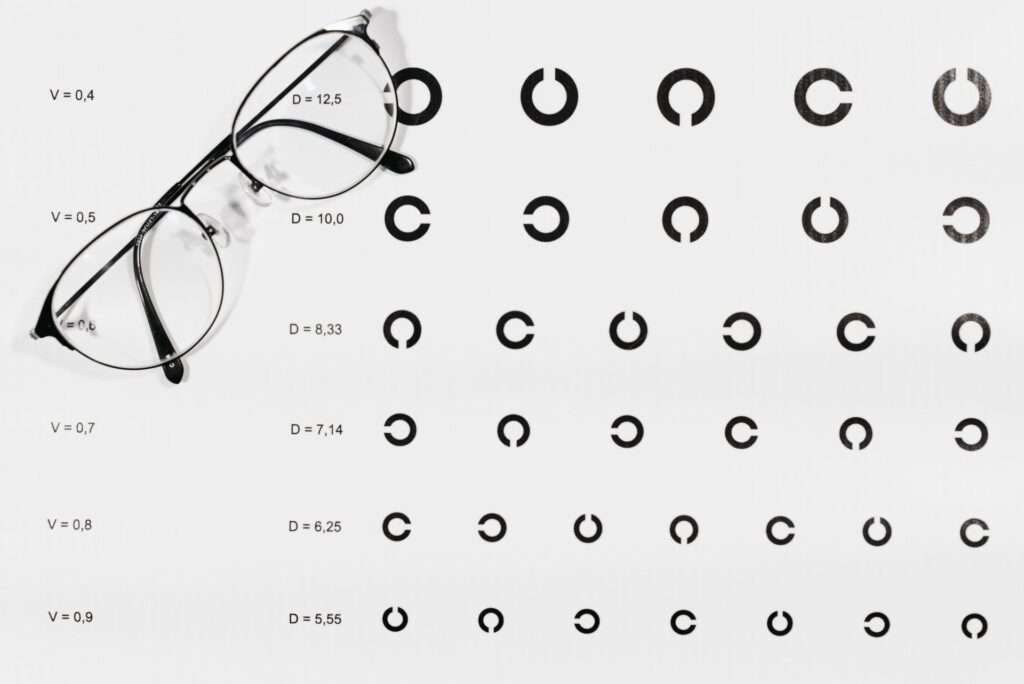
The costs of the eye test itself in detail
To claim anything, you need to know what you actually paid. The basic eye test at the optician is cheap: most opticians in Germany charge between six and fifteen euros, and many charge nothing if you buy glasses or contact lenses from them. The test itself takes only a few minutes and uses a wall chart or a vision testing device, and the certificate is issued on the spot. Because the amount is so small, some people do not even ask for a receipt, which is the first mistake. Always ask for a proper receipt with the name of the optician, the date, the amount and a description of the service, ideally the words Sehtest or eye test for driving licence. A card payment statement alone is weaker evidence, although it is better than nothing.
How to enter the costs in your tax return
In practice, most people in Germany file their tax return with software such as ELSTER, the official online portal of the tax authorities, or with a commercial programme. Work-related expenses belong in Anlage N, the annex for employment income, under Werbungskosten. Look for the sections on travel, training and further education, or other work-related expenses, and enter each cost with a short description. Medical expenses belong in the main form, the Mantelbogen, or in the annex for extraordinary expenses, depending on the software’s layout. Do not put a medical expense in Anlage N or a work expense in the medical section; the two sections are checked by different rules, and a cost in the wrong place can be missed entirely.
When a deduction will almost certainly be refused
It is just as important to know when not to claim. If you are taking the driving licence purely for private reasons, the eye test is a private cost of living, and the tax office will refuse it as a work expense. The same applies if you already hold the licence and take a new test simply because the old certificate has expired and you want to keep driving for private purposes. There is nothing wrong with that, but the cost is yours to bear. Appeals in such cases rarely succeed, because the principle is well established: the cost of obtaining a private driving licence is part of the general cost of living.
Special cases: lorry, bus and professional drivers
Professional drivers are the group for whom this topic matters most, and their situation is also the most favourable. A lorry or bus driver must hold the right class of licence and must renew the medical examination every five years, and from the age of 50 every five years with a medical certificate that includes an eye test. Each renewal costs money, and because the licence is a condition of employment, each renewal is in principle deductible as a work-related expense. The same applies to driving instructors, taxi drivers with a passenger transport licence and anyone whose employment contract states that a driving licence is required for the job.
What to do if the tax office says no
A refusal is not necessarily the end of the story. If the tax office disallows the eye test costs in your assessment, you have one month from receiving the assessment to file an objection, an Einspruch, and the objection is free. In the objection, explain briefly and politely why you believe the expense was work-related or medically necessary, and attach the documents you relied on. Most objections that succeed do so because the tax clerk did not have the full picture: perhaps the employment contract showing that the licence is required was not attached, or the medical prescription was missing. A short, well-documented objection can be enough.
How to deduct eye test costs from tax: the records you need
The tax office does not take your word for it: it wants paper. Keep the receipt from the optician, the invoice for the glasses if they are part of the claim, and the certificate from the eye test itself, and keep them together with the tax return for the year in question. A receipt should show the date, the name of the practice, a description of what was paid for, and the amount, and if any of those is missing, ask the practice for a corrected receipt before you submit the return. If you paid by card, keep the bank statement as well, because it supports the receipt, and if you paid in cash, the receipt is the only proof you have, so guard it carefully. Digital copies are usually acceptable, but a scanned copy of a faded receipt is only useful if it is still legible, so check the scan before you throw the original away.
It is also worth knowing which costs the tax office is likely to accept and which it will question. The eye test itself, when it is part of a driving licence application, is the cost most people claim, and it is also the one most likely to be accepted, because it is a direct cost of the application. Glasses and contact lenses are more complicated: if they are prescribed and needed for driving, they may be deductible as extraordinary expenses, but only the part that exceeds the reasonable burden threshold counts, and the tax office will want a prescription and a medical reason. Keep the prescription with the receipt, and be honest about what the glasses are for, because a claim that is overstated is more likely to be checked than a modest one.
Frequently Asked Questions
Can I deduct the eye test costs from tax if I need the licence only for private driving? No, not usually. A licence taken for private reasons is a private cost of living, and private living costs are not deductible, even if the test itself was compulsory. The exception is the medical route, where a genuine medical expense that exceeds your reasonable burden may still be deductible.
How much is the eye test, and does the amount matter for tax? The test at the optician usually costs between six and fifteen euros, and the certificate is normally included. On its own that amount is too small to change your tax bill, because work-related expenses only help once they exceed the employee lump sum, and medical expenses only help once they exceed your reasonable burden.
Can professional drivers deduct the eye test? Yes, in most cases. For a lorry driver, bus driver, taxi driver or driving instructor, the licence and the eye test are conditions of the job, so the costs are generally deductible as work-related expenses, provided you can prove it and your employer did not reimburse them.
Can I claim glasses or contact lenses on my tax return? Medically necessary glasses with a prescription can be claimed as extraordinary medical expenses, once your total health costs pass the reasonable burden threshold. Keep the prescription and the invoice, and note if the glasses are needed for driving.
What proof does the tax office need? The receipt from the optician or doctor with the date, amount and description of the service, the prescription if you claim glasses, and evidence that the licence is needed for your work, such as the employment contract or the training contract. Without documents, the claim will almost certainly be refused.
What if I have lost the receipt for the eye test? Ask the optician for a copy or a duplicate invoice. Most practices keep their records for several years, and a duplicate is usually issued free of charge. If no receipt can be produced, the cost cannot be claimed, so it is worth asking before you submit the return.
Conclusion
So, can you deduct the eye test costs from tax? Sometimes yes, often no, and the difference almost always comes down to the reason for the licence and the quality of your documents. If the licence is needed for your job or your training, the eye test, the medical examination, the glasses and the travel are all part of a work-related claim that is worth making, especially once your total work expenses pass the lump sum. If the licence is purely private, the eye test is a private cost, and only the medical route, with its higher threshold, may help, usually only in a year when you have other large health costs as well.
The practical steps are simple: ask for a receipt for every cost, keep the prescription and the employment or training contract, put everything in one folder for the tax year, and enter the costs in the right section of the return, with a short explanation if the claim is not obvious. Do not expect a fortune: the tax saving from an eye test alone is a few euros at most. But as part of a careful, honest claim for the full cost of obtaining and keeping a driving licence, it is a real saving, and it costs you nothing more than a receipt and a little organisation. When in doubt about a large claim, ask a tax adviser, because a short consultation is usually cheaper than a refused claim.