Which Visual Acuity for Which Licence Class?

Which visual acuity for which licence class? It is one of the most practical questions in the whole driving licence process, because the answer changes depending on what you want to drive. A car driver needs a visual acuity, or visus, of 0.7 with both eyes together, while a lorry or bus driver needs 0.8 in the better eye and 0.5 in the weaker eye, as well as a full visual field and good colour vision. A moped rider, a motorbike rider, and a tractor driver each have their own rules, and it is easy to get them mixed up. This guide sets out the visual acuity requirements for every licence class in Germany, explains how the visus is measured, and tells you what happens if your vision falls short.
Visual acuity is a simple idea with a confusing name. In Germany it is measured as a decimal, the visus, where 1.0 is normal vision, 0.7 is the minimum for a car licence, and 0.5 is the minimum for one eye in the professional classes. The visus is measured by reading letters or symbols on a chart, with and without your glasses or contact lenses, and the result is recorded for each eye separately and for both eyes together. The eye test for your driving licence is not a test of whether you have perfect vision. It is a test of whether your corrected vision meets the legal minimum for the vehicle you want to drive, and most people who wear glasses or contact lenses pass it without any difficulty.
Understanding the limits matters because it can save you time, money and disappointment. If you are applying for a car licence and your visus is 0.6, a stronger pair of glasses may be all you need to reach 0.7, and you can rebook the test once they are ready. If you are applying for a lorry licence and your weaker eye is 0.4, you will need to see an ophthalmologist, and you may need to accept a restriction on the classes you can hold. Knowing the numbers before you book the test helps you to prepare properly, to bring the right correction, and to avoid a failed test that could have been prevented. This article gives you those numbers, class by class.
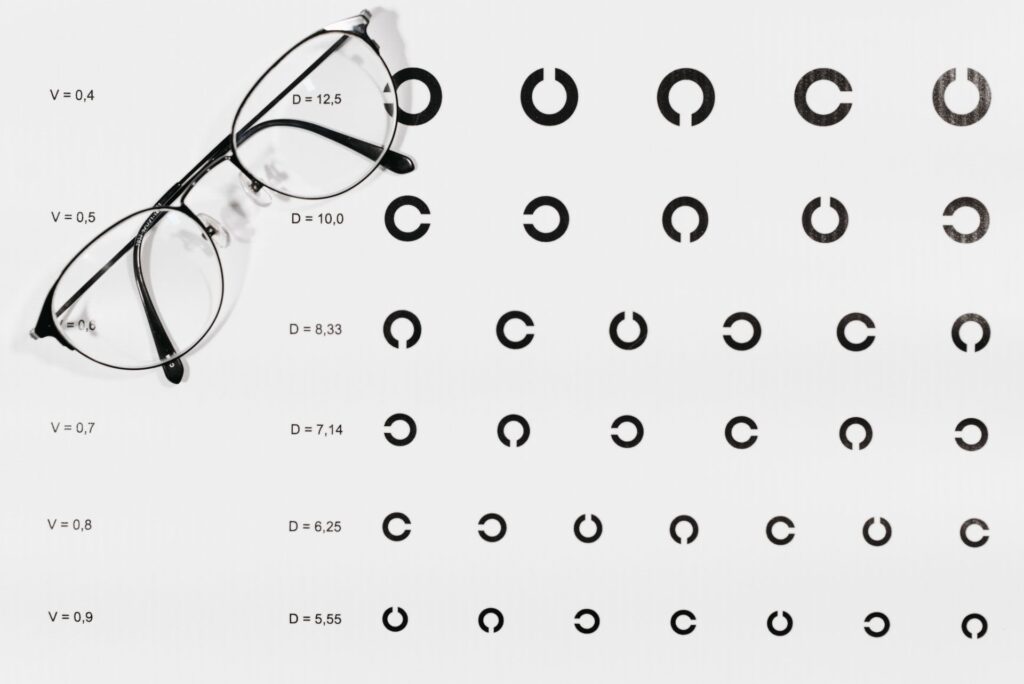
What visual acuity means, and how it is measured
Visual acuity is the sharpness of your vision: how small a detail you can see at a given distance. In the eye test, you look at a chart of letters, numbers or Landolt rings, which are circles with a gap in them, and you read down the lines until the letters become too small to see. Each line on the chart corresponds to a visus value, and the smallest line you can read reliably gives your visus for that eye. The test is done at a fixed distance, usually five or six metres, and it is done first without correction, then with your glasses or contact lenses, so that the optician can see both your uncorrected and your corrected vision.
The visus is recorded as a decimal, and the scale is easy to understand once you know it. A visus of 1.0 means you can see at six metres what a person with normal vision can see at six metres. A visus of 0.7 means you need to be a little closer, or the letters need to be a little bigger, and a visus of 0.5 means you can see about half as well as a person with normal vision. These numbers are not grades, and a visus of 0.7 does not mean that your vision is 70 percent as good as it should be. It means that your vision meets the legal minimum for driving a car, which is the standard that matters for your licence. For a full explanation of the 0.7 value, read our article on what visual acuity 0.7 means for your driving licence.
There are three numbers that matter in the eye test: the visus of your right eye, the visus of your left eye, and the visus with both eyes together, which is called binocular vision. For most licence classes, the binocular visus is the one that decides whether you pass, because that is how you drive, with both eyes open. For the professional classes, the visus of each eye matters separately as well, because a lorry or bus driver needs good vision in both eyes, not just good binocular vision. That is why the optician tests each eye separately, by covering one eye at a time, and then tests both eyes together, and records all three numbers on the certificate.
Class B, A and AM: the 0.7 rule for cars, motorbikes and mopeds
For the most common licence classes, the rule is straightforward. Class B, which is the car licence, class A, which is the motorbike licence, and class AM, which is the moped licence, all require a binocular visual acuity of at least 0.7, with correction if you need it. That means that, with both eyes together and your glasses or contact lenses on, you must be able to read the 0.7 line on the eye chart. There is no separate minimum for each eye in these classes, unless one eye is very weak, and the test is the same whether you are 17 or 70, whether you are applying for the first time or renewing, and whether you wear glasses or not.
The 0.7 rule sounds strict, but in practice it is a low bar, and most people meet it easily. A visus of 0.7 is well below normal vision, and many people who have never worn glasses, and who think their vision is fine, actually have a visus of 1.0 or better. If you do wear glasses or contact lenses, and your prescription is up to date, you will almost certainly meet the 0.7 limit with them on. The people who fall short are usually those whose prescription is out of date, or who have an eye condition that has not been treated, and in most of those cases a visit to the optician or the ophthalmologist can put it right. For the differences between the classes, see our guide to the eye test differences between licence classes B, C and D.
One special case is worth knowing about. If one of your eyes is very weak, or blind, you can still get a class B licence, provided that your good eye has a visus of at least 0.7 and your visual field is normal. This is known as monocular vision, and it is allowed for cars and motorbikes, although it is not allowed for lorries and buses. If you have monocular vision, the eye test will focus on your good eye, and the ophthalmologist may need to confirm that your visual field is wide enough. That is a matter for the doctor, not the optician, and it will be recorded on your certificate.
Classes C, C1, D and D1: the professional limits
For professional drivers, the requirements are much stricter, and they are tested in a different way. Class C is the lorry licence, class C1 is the smaller lorry licence, class D is the bus licence, and class D1 is the smaller bus licence. For all four classes, you need a visual acuity of at least 0.8 in your better eye, and at least 0.5 in your weaker eye, with correction if you need it. That is a higher bar than the 0.7 binocular rule for cars, and it means that both eyes must be good, not just the two together. If your weaker eye is only 0.4, you will not pass the professional eye test, even if your binocular visus is 1.0, and you will need to see an ophthalmologist to find out whether there is a way to improve it.
The professional classes also require a visual field test and a colour vision test, which are not part of the car eye test in the same way. The visual field is the area you can see at the sides while you are looking straight ahead, and for a lorry or bus driver it must be at least 160 degrees wide in the horizontal direction, with no significant blind spots in the centre. The colour vision test is usually the Ishihara test, with coloured dots forming numbers, and you must be able to read them correctly. The reason for these extra requirements is that professional drivers spend many hours on the road, they drive heavy vehicles that are harder to stop, and they carry passengers or cargo, so the safety margin needs to be higher. Our guide to the eye test for professional drivers explains the full professional test in detail.
Professional drivers also have to repeat the eye test more often than car drivers. The lorry and bus licences are issued for five years at a time, and every time you renew, you need a new eye test, a medical examination, and, from the age of 50, a more detailed medical check. That means that a professional driver’s vision is checked regularly throughout their career, and any deterioration is picked up early. If you are planning to become a professional driver, it is worth having your eyes checked by an ophthalmologist before you start the training, so that you know whether your vision meets the professional limits before you spend money on a course. That check can save you a lot of time and disappointment.
Tractors, and the other licence classes
There are other licence classes with their own rules, and they are worth knowing about if you are applying for one of them. Class T, the tractor licence, and class L, the agricultural vehicle licence, both require a binocular visus of at least 0.7, the same as a car, and the test is the same simple eye test that you take at the optician. Class CE, which is a lorry with a trailer, and class DE, which is a bus with a trailer, follow the same rules as classes C and D, because they are professional classes. The pattern is simple: if the class is a professional class, the limits are 0.8 and 0.5, and if it is a private class, the limit is 0.7 binocular.
There is one more class to mention, and it is the one that confuses the most people: class B with code 96, or class BE, which lets you tow a heavier trailer with a car. These are still car classes, and the eye test requirement is still 0.7 binocular, the same as class B. You do not need a professional eye test to tow a trailer, and you do not need to repeat the test when you add the trailer entitlement. That is a common misunderstanding, and it can lead people to book a more expensive professional eye test than they need, or to worry unnecessarily about their vision. If you are only adding a trailer entitlement to a car licence, the ordinary eye test is enough.
Finally, remember that the licence class you apply for decides the eye test you take, not the other way around. If you take the simple optician’s eye test for class B, and you later decide that you want a lorry licence, you will need to take a new, more detailed eye test, because the simple test does not cover the professional requirements. It is better to decide which classes you want before you take the test, so that you can book the right one first time. If you are unsure, tell the optician which classes you are thinking about, and they will advise you on which test you need.
What to do if your vision falls short
If your vision falls short of the limit for your licence class, the first step is to find out why, because the reason decides what you can do next. In most cases, the reason is simple: your prescription is out of date, and you need a stronger pair of glasses or contact lenses. Book an eye test at the optician, have your prescription updated, and then take the driving licence eye test again with the new correction. That is the most common fix, and it works for the large majority of people who fall short, because the limit is a low one, and a current prescription is usually enough to meet it.
If a new prescription does not get you to the limit, the next step is to see an ophthalmologist. The ophthalmologist can check for cataracts, for a problem with the retina, for glaucoma, or for another eye condition that is affecting your vision, and they can tell you whether it can be treated. Cataracts, for example, can often be corrected with a simple operation, and after the operation the visus improves dramatically, so a person who could not pass the eye test before the operation can pass it easily afterwards. That is a medical question, and it needs a doctor, not an optician, and it is worth pursuing, because the treatment may improve your vision for driving and for everyday life as well.
If, after treatment, your vision still does not meet the limit for the class you wanted, you may need to accept a lower class, or a restriction. For example, if you cannot meet the professional limits for a lorry licence, you may still be able to hold a car licence, and you may still be able to drive for a living in a car, as a courier or a taxi driver, rather than in a lorry. That is a disappointment, but it is not the end of driving, and it is much better than trying to drive a vehicle that you cannot see well enough to control safely. Your ophthalmologist and the licensing office can advise you on your options, and on whether an exception is possible in your case.
How to prepare for the eye test for your licence class
Preparing for the eye test is simple, and it is the same whatever class you are applying for. Make sure your glasses or contact lenses are up to date by having a routine eye test at the optician in the weeks before your driving licence test, and bring the glasses or contact lenses you intend to drive with, not an old pair. Bring your glasses as well as your contact lenses if you have both, so that you can switch if there is a problem, and bring your prescription if you have it, in case the optician needs to check it. That preparation takes a few minutes, and it removes the most common reasons for a failed test.
On the day of the test, arrive rested, and avoid screens for a while before the appointment, so that your eyes are not tired. Do not take the test after a long night, or after a long drive, if you can avoid it, because tired eyes can read a line or two worse than rested eyes, and that can be the difference between passing and failing when you are close to the limit. If you wear contact lenses, put them in well before the test, so that they have settled, and bring your lens solution and your glasses as a backup. These are small things, but they make the test as fair as possible, and they help you to get a result that reflects your real vision.
Finally, know your numbers before you go. If you know that you need 0.7 for a car, or 0.8 and 0.5 for a lorry, you will know what to expect, and you will not be surprised by the result. If you are not sure which class you need, or which limits apply to you, ask your driving school, or ask the optician before the test starts. They deal with these questions every day, and they will be happy to explain. For a general overview of the whole process, read our guide to how the driving licence eye test works.
Frequently Asked Questions
What visual acuity do I need for a car licence?
For class B, you need a binocular visual acuity of at least 0.7, with glasses or contact lenses if you use them. There is no separate minimum for each eye, unless one eye is very weak or blind.
What visual acuity do I need for a lorry or bus licence?
For classes C, C1, D and D1, you need at least 0.8 in your better eye and at least 0.5 in your weaker eye, plus a visual field of at least 160 degrees and a colour vision test.
Is a visus of 0.7 the same as having 70 percent vision?
No. The visus is a decimal on a chart scale, not a percentage of normal vision. A visus of 0.7 is below normal vision but well above the level at which driving becomes unsafe, which is why it is the legal minimum for cars.
Can I get a licence if one eye is blind?
Yes, for cars and motorbikes, if your good eye has a visus of at least 0.7 and your visual field is normal. This is called monocular vision, and it is not allowed for lorries and buses.
Does the same limit apply to mopeds?
Yes. Class AM, the moped licence, has the same 0.7 binocular requirement as class B and class A, and the same simple eye test at the optician.
Conclusion
The visual acuity you need depends on the licence class, and the rules are simple once you know them. For cars, motorbikes and mopeds, the limit is 0.7 with both eyes together, and for lorries and buses it is 0.8 in the better eye and 0.5 in the weaker eye, with extra tests for the visual field and colour vision. Knowing those numbers before you book the test lets you prepare properly, and it removes the most common reasons for a failed test.
In practice, most people who wear glasses or contact lenses pass the eye test without any trouble, because a current prescription is usually enough to meet the limit. If your vision does fall short, do not assume that you can never drive. Start with a new prescription, and if that is not enough, see an ophthalmologist, because many of the conditions that reduce visual acuity can be treated. With the right correction, and the right licence class for your vision, the road is open.