Landolt Rings in the Eye Test: How to Read the Openings Correctly

If you take the driving licence eye test in Germany, you will almost certainly meet the Landolt rings. They are the little broken circles that appear on the eye chart, and your job is to say where the gap in each circle points. It sounds simple, and for most people it is, but many learner drivers feel nervous because they have never seen this kind of test before. The good news is that you can understand the Landolt rings eye test in a few minutes, and a little practice is all it takes to feel confident.
This article explains what Landolt rings are, how to read the openings correctly, why this symbol is used instead of letters, and which mistakes you should avoid. You will also learn how the test is carried out step by step, how the result is scored, and how you can practise at home. By the end, the Landolt rings will feel familiar, and you will know exactly what to do on the day of your eye test.
What Landolt rings are
A Landolt ring is a circle with a small gap on one side, named after the Swiss ophthalmologist Edmund Landolt, who introduced it for measuring visual acuity. The ring looks a bit like the letter C, but the opening can point in any of eight directions, not just to the right. The task is always the same: look at the ring and say, point or show in which direction the gap is. There is no reading involved and no alphabet to know, which makes the test fair for everyone, including people who cannot read well or who are not sure about letters.
The test is standardised under the German norm DIN 58220, which means that every optician in Germany uses rings of the same shape and the same proportions. The thickness of the ring and the width of the gap are always exactly one fifth of the diameter of the ring, so the test is comparable from one optician to another. The rings get smaller in steps, and the smallest row you can still read correctly tells the examiner how sharp your vision is. That result is expressed as your visual acuity, or visus.
How the rings are printed and shown
In a classic eye test, the Landolt rings are printed on an eye chart that hangs on a wall at a fixed distance, usually five metres or a similar standard distance, depending on the device. Modern opticians often use an electronic testing device instead, where the rings appear on a screen and the examiner changes the size with a remote control. Both methods work in exactly the same way, and the result is equally valid.
The chart is organised in rows. Each row contains several rings of the same size, and each new row is a little smaller than the one before. You start with the largest rings, which are easy to see, and work your way down until the rings become so small that you can no longer tell where the opening is. The examiner notes the last row you could read correctly, and that row determines your visual acuity. Large, clear rings at the top and tiny rings at the bottom are completely normal, so do not be surprised when the bottom rows look almost impossible.
How the Landolt test is carried out
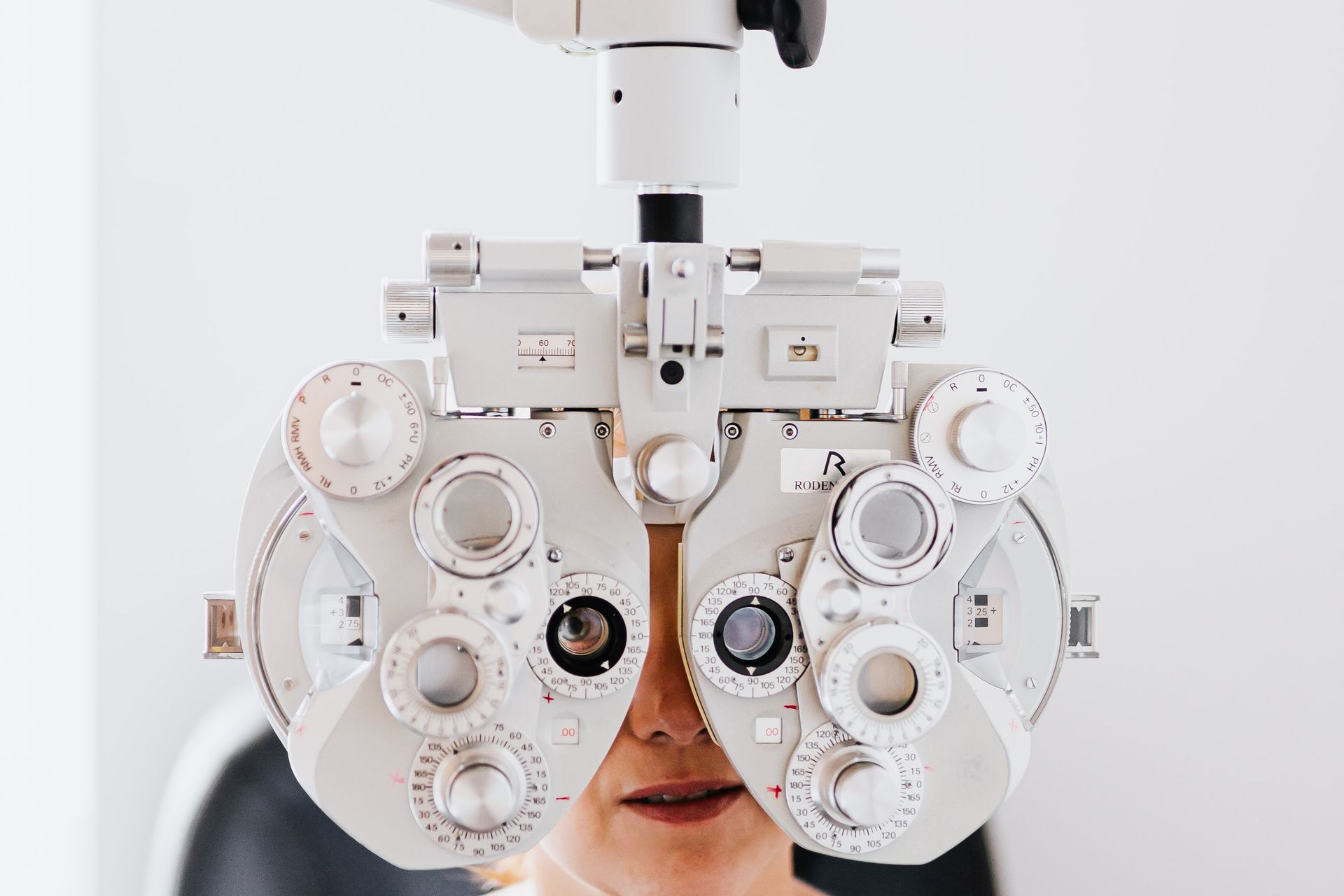
The test follows the same routine at every optician. You sit at a fixed distance from the chart or the screen, and the optician covers one of your eyes. You then read the rings row by row, saying the direction of each opening out loud. After the first eye, the cover moves to the other eye, and the same thing is repeated. Finally, both eyes are tested together. The whole process takes only a few minutes, and you can read more about the exact sequence in our guide to the eye test procedure, which describes each round in detail.
The examiner will point to the rings one by one, or ask you to read a full row at a time. You do not need to be quick, and it is fine to take a moment to look carefully. If you are not sure about a ring, say so honestly instead of guessing wildly, because the examiner is testing your real vision, not your luck. The last row you can still read correctly decides your result, so a careful answer is worth more than a lucky guess on a smaller row.
Why Landolt rings and not letters
Many people wonder why the test does not simply use letters or numbers, which would feel more natural. The reason is that Landolt rings test only your vision, and nothing else. Letters are influenced by how well you can read, by your education and by your language, and a person who knows a letter by heart can guess it from a blurry shape. A Landolt ring has no meaning of its own, so the only way to answer correctly is to see the gap clearly.
This neutrality is a big advantage, because it makes the test fair for everyone, regardless of age, education or native language. It also makes the result more reliable, because the examiner can be sure that a correct answer really means that your eyes saw the opening. That is why the Landolt ring has become the international standard for visual acuity testing, and why the German driving licence test has used it for so many years.
Common mistakes with Landolt rings
The most common mistake is guessing too quickly. When a ring is at the edge of what you can see, the opening seems to be in one direction, but it is really just a blur. If you call out a direction without looking properly, you can miss a row that you might have read correctly with a little more patience. Take your time, blink normally, and look at the ring for a moment before you answer. The examiner is in no hurry, and a calm answer is always better than a fast one.
Another mistake is moving closer to the chart or squinting hard to make the rings sharper. Squinting changes the shape of your eye and can make a blurry ring look clearer for a moment, but it does not reflect your normal vision, and the examiner will notice it. Sit still, keep your head in the normal position, and use your glasses or contact lenses if you have them. If you feel nervous, tell the optician. A short break and a friendly word are often enough to relax and do much better.
How to practise the Landolt rings at home
You can easily practise the Landolt rings before your test, and it really helps. Print a Landolt chart from the internet or use one of the free online trainers, and read the rings from a distance of about three to five metres. Start with the larger rings and work your way down, just like at the optician. If you practise with one eye covered, you will also find out whether one eye is weaker than the other, which is useful to know in advance.
Practising does not change your eyesight, but it does make you familiar with the task, so you will not be surprised by it on the day. Our guide section has more advice on preparation, including what to bring to the test and how to stay calm. If your practice shows that you cannot reach the required rows even with glasses, have your eyes checked before the official test, so you can get a stronger prescription in time.
What the result means
Your result is given as a visual acuity value, such as 0.7 or 1.0. For a Class B driving licence, your better eye must reach at least 0.7 and your weaker eye at least 0.1, with or without your visual aid. If you pass, you receive the official certificate immediately, and it is valid for two years. The certificate is the proof you need for your driving licence application, together with your first aid course certificate and a passport photo.
If you do not pass, the reason is usually simple: your vision is not sharp enough with your current glasses, or you have not used a visual aid at all. A new eye check and a stronger prescription are often enough to pass on the second attempt. The Landolt test itself is not something you fail because of a lack of knowledge, and there is no reason to be afraid of it once you know how it works.
Do you need glasses to pass the Landolt test?
You do not need a perfect result without glasses to pass the Landolt test, because the test is always taken with your usual visual aid. If you wear glasses or contact lenses in everyday life, you take the test with them, and the result counts with the correction. The driving licence only requires that you reach a visual acuity of 0.7 on your better eye and 0.1 on your weaker eye with your glasses or contact lenses. That means that glasses are not a problem for the test, they are part of it. Many people who wear glasses every day are surprised to learn that the test is not about your eyesight without correction, but about how well you see in the way you normally drive. If your glasses are up to date and in good condition, you should be able to read the Landolt rings clearly, and the test confirms that your correction is good enough for driving. If you notice that the rings look blurry even with your glasses, tell the optician before the test, because the problem may be a scratched lens, a dirty lens, or a prescription that is no longer correct.
If you do not wear glasses but you suspect that your vision has become weaker, it is worth having your eyes checked before the official test. An optician can measure your visual acuity in a few minutes and tell you whether you need glasses for driving. If the result is below 0.7 on your better eye without glasses, you will need a correction, and the optician can fit you with glasses that bring you up to the required level. There is no shame in needing glasses, and the code number 01 on your driving licence simply means that you drive with a visual aid, which is very common. The important thing is to find out before the official test, because if you fail and then get glasses, you have to repeat the test and pay for it again. A quick check at the optician before the test saves you time and money, and it also takes away the worry of not knowing whether your vision is good enough.
On the day of the test, bring the glasses or contact lenses that you normally wear for driving, and make sure that they are clean and in good condition. If your glasses are scratched or your contact lenses are dry, the result can be worse than it should be, even if your prescription is correct. Take a spare pair with you if you have one, in case a lens slips or a frame breaks on the way to the optician. If you have recently changed to a new prescription, wear the new glasses for a few days before the test, so that your eyes get used to them and you feel confident. When you sit for the Landolt test, look straight at the rings and take your time, because the test allows you to answer at your own pace and there is no need to rush. If you are not sure about an opening, say so honestly, because guessing can make the result less reliable, and the optician will repeat the row or move to a larger ring so that the result is fair.
If you need glasses but you do not have a pair yet, do not book the official test until you have been fitted. The optician can measure your vision and order glasses for you, and most simple glasses are ready within a few days. When the glasses arrive, wear them every day for a short time before the test, and check that you can read small print and road signs with them. If you wear contact lenses only for sport or special occasions, decide in advance whether you will take the test with lenses or with glasses, and use the same visual aid for the test as you plan to use for driving. The result of the test is recorded with the visual aid you wore, so you must drive with the same type of correction afterwards. That is why it is important to choose the visual aid that works best for you in normal driving, and not just the one that feels easiest on the day of the test.
Conclusion
Landolt rings look unusual at first, but they are a fair and simple way to measure your vision. The task is always the same: find the gap and say which way it points. The rings get smaller row by row, and the smallest row you can read correctly tells the examiner your visual acuity. If you understand the eight directions, take your time, and practise a little at home, there is nothing to worry about. Most people pass the test on the first try, especially with glasses or contact lenses, and the certificate is in your hand within ten minutes.
Frequently asked questions
How many directions can a Landolt ring point in?
Eight: up, down, left, right, and the four diagonals. The opening can be in any of these eight directions, and you have to say which one it is.
Why are Landolt rings used instead of letters?
Because they test only your vision. Letters can be guessed from memory or from language knowledge, while a Landolt ring can only be answered correctly if you really see the gap.
What is the DIN 58220 standard?
It is the German standard for the Landolt eye test. It fixes the proportions of the rings, so that the test is the same at every optician and the results are comparable.
Can I practise the Landolt rings before the test?
Yes. Free Landolt charts and online trainers are available, and a few minutes of practice will make you familiar with the task and much more relaxed on the day.
What visual acuity do I need for Class B?
Your better eye must reach at least 0.7 and your weaker eye at least 0.1, with glasses or contact lenses if you use them.
How long does the Landolt test take?
Only a few minutes. The whole eye test appointment, including the certificate, takes about ten minutes.
What happens if I cannot see the opening of a Landolt ring?
Say so honestly. The examiner will move on to the next ring, and the test result is based on the smallest rings that you can read reliably. You do not fail the test because of a single ring. The rings are shown in several sizes and directions, and the examiner looks for a consistent result across all of them. A single missed opening is normal and does not change the result.
How many Landolt rings do I have to read correctly to pass?
There is no fixed number of rings that you must read correctly. The examiner shows rings in decreasing sizes and notes the smallest size that you can read reliably for each eye. If your visual acuity reaches 0.7 on the better eye and 0.1 on the weaker eye, you pass. The test is about the smallest size you can read, not about a number of correct answers.