Eye Test in Berlin: Where Expats Can Take the Driving Licence Eye Test

Intro
If you are an expat living in Berlin and you need a German driving licence, one of the first steps on your list is the eye test. In Germany, every first-time licence applicant has to prove that their vision meets the legal minimum, and the official eye test — the Führerschein-Sehtest — is how you do it. The good news is that getting an eye test in Berlin is quick, cheap, and easy to arrange, even if your German is still a work in progress.
Berlin is home to hundreds of opticians, from big chains like Fielmann and Apollo to small independent shops in every Kiez, and almost all of them offer the official driving licence eye test. Most tests take less than fifteen minutes, cost around six to seven euros, and you can usually walk in without an appointment. The certificate you receive is valid throughout Germany, so an eye test done in Berlin works just as well for an application in Munich, Hamburg, or anywhere else.
This guide explains exactly where to take an eye test in Berlin, what it costs, what to bring, whether you can do it in English, and what happens if you do not pass on the first try. By the end, you will know how to get this step done in a single lunch break.
Where to Take the Eye Test in Berlin
Big optician chains: Fielmann and Apollo
The simplest option for most expats is one of the big chains. Fielmann has more than a dozen branches across Berlin — on Kurfürstendamm, Friedrichstrasse, Alexanderplatz, in the malls at Potsdamer Platz and Gesundbrunnen, and in neighbourhood high streets from Prenzlauer Berg to Steglitz. Apollo Optik is similarly widespread, with branches in most shopping centres and main streets.
Both chains offer the official eye test for the driving licence, and at Fielmann the test is often free as a customer service. Apollo charges the standard fee in most branches, but the price is always in the same low single-digit range. The big advantage of the chains is that they are used to international customers: staff in central Berlin branches often speak English, the process is standardised, and you can usually walk in without booking ahead.
For a detailed comparison of the two chains, read our guide to the eye test at Fielmann and Apollo.
Independent opticians in your Kiez
Berlin’s independent opticians are another excellent choice, and in many neighbourhoods they are actually the more convenient option. A small shop on your own street can do the same official test, issue the same certificate, and often give you more personal attention than a busy chain branch. Prices are similar — the fee is set by law at 6.43 euros, so no optician can charge much more than that for the standard test.
Independent opticians are also a good pick if you wear glasses or contact lenses already, because they can check your current prescription at the same time and tell you honestly whether your glasses are good enough for the test. Just make sure the shop explicitly offers the Führerschein-Sehtest; almost all of them do, but a quick phone call or a look at the shop window will confirm it.
Can you take the eye test at a driving school in Berlin?
Some Berlin driving schools offer the eye test on their own premises, or they have a partner optician nearby. This can be convenient if you are already enrolled, because you can combine the test with your registration. However, the test itself is always carried out by a qualified optician or ophthalmologist, not by the driving school staff, and the certificate is exactly the same as one from any optician. If your driving school offers it, take the convenience — but there is no need to wait for a school appointment when any optician on your street can do it today.
The ophthalmologist option
You do not need to see an eye doctor for the standard driving licence eye test. The test at the optician is fully sufficient for a normal Class B car licence. An ophthalmologist — an Augenarzt — only becomes necessary if the optician’s test reveals a problem, if you have a known eye condition, or if you are applying for a lorry or bus licence, where a full medical examination is required.
If you do need an ophthalmologist in Berlin, you can find English-speaking eye doctors in most central districts, particularly around Charlottenburg, Mitte, and Prenzlauer Berg. Expect longer waiting times for an appointment and a higher fee than at the optician.
What the Eye Test Costs in Berlin
The fee for the official driving licence eye test is fixed by law across Germany at 6.43 euros. This applies in Berlin just as it does everywhere else, so you should never pay significantly more for the standard test. Some opticians, especially Fielmann, offer the test for free.
What can cost extra is anything beyond the standard test. If the optician finds that your vision is below the required level and you need new glasses, the glasses themselves are a separate purchase. If you are referred to an ophthalmologist, the eye doctor’s examination is billed separately, usually according to the official medical fee schedule, and can cost anywhere from 30 to over 100 euros depending on what is examined.
For most people, though, the eye test in Berlin costs either nothing or 6.43 euros. It is one of the cheapest steps in the whole driving licence process.
What to Bring to Your Eye Test in Berlin
Bringing the right things makes the appointment smooth and avoids a wasted trip. Here is what you need:
- A valid photo ID — your passport or your German residence permit. The optician has to record your identity on the certificate.
- Your glasses or contact lenses — if you normally wear them. The test is done with your usual visual aids, and the result determines what is entered on your licence.
- Your glasses prescription — if you have one. It is not required, but it helps the optician if your glasses turn out to be too weak.
- Your contact lens details — if you wear lenses, bring the packaging or know your lens strength. The optician needs to know exactly what correction you are wearing.
- Payment — 6.43 euros in cash or by card. Most Berlin opticians accept cards, but a small independent shop may prefer cash.
You do not need a referral from a doctor, you do not need an appointment at most places, and you do not need to bring any forms. The optician has the official certificate form and fills it in on the spot.
Can You Do the Eye Test in English in Berlin?
Yes — in most cases. Berlin is one of the most international cities in Germany, and opticians in central districts are used to English-speaking customers. The eye test itself barely needs language at all: the Landolt rings you have to read are just circles with a gap, and you indicate the direction of the gap by pointing or saying “up”, “down”, “left”, or “right”. Even with very little German, you can complete the test.
That said, a few practical tips help:
- Choose a central branch. Opticians on Kurfürstendamm, in Mitte, or near Alexanderplatz are more likely to have English-speaking staff than a small shop in a quiet residential area.
- Learn five words. “Oben” (up), “unten” (down), “links” (left), “rechts” (right), and “Sehtest” (eye test) cover almost everything the test itself requires.
- Ask in advance. If you book by phone or online, ask “Sprechen Sie Englisch?” — do you speak English? Most staff will answer honestly.
- Bring a German-speaking friend if you are nervous, though in practice you will rarely need one.
The certificate itself is a standard German form, and the driving licence authority — the Fahrerlaubnisbehörde — accepts it as it is. There is no English version, and none is needed.
Walk In or Book an Appointment?
Most Berlin opticians accept walk-ins for the driving licence eye test. You can simply walk into a Fielmann, Apollo, or independent optician, say “Ich brauche einen Führerschein-Sehtest”, and be tested within a few minutes if they are not busy.
Booking an appointment has advantages, though. It guarantees a time slot, it lets you confirm in advance that English is spoken, and it avoids waiting on a busy Saturday, when opticians are at their fullest. Many chains let you book online in a couple of minutes, and some offer evening appointments for people who work during the day.
Our advice: if you are going on a weekday morning, just walk in. If you can only go on a Saturday, or you want to be sure about English, book ahead. Either way, the test itself takes about ten to fifteen minutes.
What Happens During the Test
The driving licence eye test in Berlin follows the same procedure as everywhere in Germany. You sit in front of a test chart or look into a vision testing device, and you read Landolt rings — circles with a small opening on one side — getting smaller as the test goes on. You say or point in the direction of each opening.
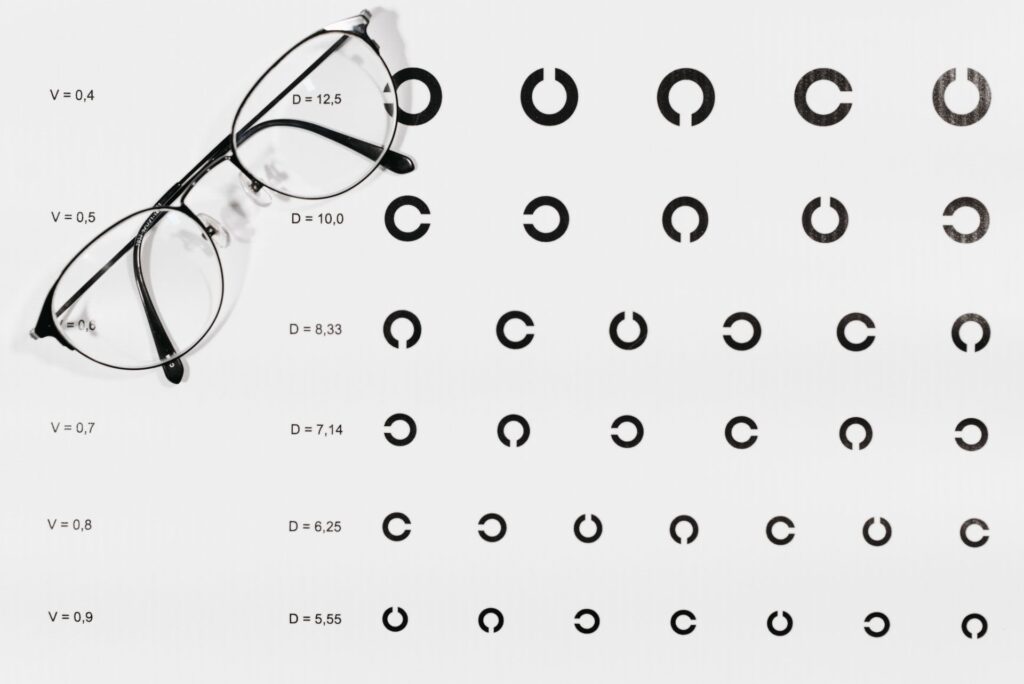
The optician tests each eye separately and then both eyes together. To pass for a Class B car licence, you need a visual acuity of at least 0.7 on the better eye, with or without your glasses or contact lenses. The colour vision part is simple: you will be asked to identify colours, usually with Ishihara plates, the familiar circles made of coloured dots.
After the test, the optician fills in your certificate, the Sehtest-Bescheinigung. It states your name, date of birth, the result, and whether you need glasses or contact lenses while driving. Keep this certificate safe — you need the original when you apply for your licence at the Bürgeramt or the Fahrerlaubnisbehörde.
Which Berlin Districts Are Best for Expats?
Every district has opticians, but some are more convenient for English speakers:
- Mitte — the highest density of chain branches and the most English spoken. Alexanderplatz and Friedrichstrasse are the easiest places to find a walk-in test.
- Charlottenburg and Wilmersdorf — many independent opticians and several English-speaking ophthalmologists around Kurfürstendamm.
- Prenzlauer Berg and Kreuzberg — plenty of opticians, relaxed atmosphere, and staff used to international residents.
- Neukölln and Wedding — good coverage and often shorter waiting times than the centre.
- Steglitz and Zehlendorf — quieter branches where you may get more time and attention.
Wherever you live, there is almost certainly an optician within a ten-minute walk that offers the test. Berlin’s density of opticians is one of the highest in Germany.
What If You Fail the Eye Test in Berlin?
Failing the eye test is not the end of the road — it is common, and it is fixable. The most frequent reason is simply that your glasses are out of date or your prescription has changed. In that case, the optician will usually test you with a trial set of lenses to find the correction you need, and you can order new glasses on the spot or take the prescription elsewhere.
If the problem is more than just an outdated prescription, the optician will refer you to an ophthalmologist. The eye doctor examines your eyes thoroughly and issues a medical report that may still allow you to get your licence, possibly with conditions such as wearing glasses or restrictions on night driving.
You can retake the eye test as soon as the underlying issue is fixed — there is no waiting period for a simple retest after new glasses. The certificate is only issued when you pass, so a failed attempt does not go on any record that harms your application.
Combining the Eye Test with Your Licence Application
The eye test certificate is one of several documents you need for your driving licence application in Berlin. The others include a first aid course certificate, a biometric passport photo, your ID, and proof of residence. The eye test certificate is valid for two years from the date of issue, so you do not need to rush your application the same week — but do not leave it so long that it expires.
In Berlin, you submit your application at the Bürgeramt or directly at the Fahrerlaubnisbehörde, depending on your situation. Expats converting a foreign licence follow a slightly different process from first-time applicants, but the eye test requirement is identical for both.
If you are converting a non-EU licence, the eye test is still required, and the same opticians can do it. The certificate does not distinguish between first-time and conversion applications.
Conclusion
Getting an eye test in Berlin as an expat is one of the easiest parts of the German driving licence process. Walk into almost any optician — a Fielmann or Apollo branch in the centre, or an independent shop in your own Kiez — bring your ID and your glasses, pay 6.43 euros or nothing at all, and walk out fifteen minutes later with the certificate you need.
Choose a central branch if you want to be sure of English, bring your glasses or lenses, and do not worry about the language: the Landolt rings speak for themselves. If you fail, it is almost always a matter of an outdated prescription, and a new pair of glasses solves it. Book your test this week, and one more box on the way to your German driving licence will be ticked.
Frequently Asked Questions
How much does the eye test cost in Berlin?
The official fee is 6.43 euros throughout Germany, including Berlin. Many Fielmann branches offer it for free, and you should not pay much more than the official fee anywhere.
Do I need an appointment for the eye test in Berlin?
No, most opticians accept walk-ins. Booking ahead is useful on Saturdays or if you want to confirm English-speaking staff, but on a weekday you can usually just walk in.
Can I take the eye test in English in Berlin?
Yes. Opticians in central Berlin are used to English-speaking customers, and the test itself uses Landolt rings, which need almost no language. Learning “oben, unten, links, rechts” covers the whole test.
Where is the best place for an expat to take the eye test in Berlin?
Fielmann and Apollo branches in Mitte, Charlottenburg, or Prenzlauer Berg are the easiest choices: central, English-friendly, and usually walk-in. Independent opticians in your own neighbourhood work just as well.
How long is the Berlin eye test certificate valid?
The certificate is valid for two years from the date of issue, throughout Germany. You can use a Berlin certificate for a licence application in any German city.
Do I need a referral from a doctor for the eye test?
No. You can go directly to any optician for the driving licence eye test. A referral or an ophthalmologist is only needed if the optician finds a problem or if you are applying for a lorry or bus licence.