Driving Licence Eye Test for Class B: Procedure, Costs and Requirements

Almost everyone who applies for a driving licence in Germany has to take an eye test first, and for most people that means the driving licence eye test for Class B. It is a short, standardised check of your vision, and you need the official certificate before the driving licence authority will process your application. Many learner drivers worry about this test far more than they need to, because the procedure is simple, it only takes about ten minutes, and it costs less than ten euros in most cases.
In this guide you will learn exactly how the driving licence eye test for Class B works, what the examiner checks, what visual acuity you need, what it costs in 2026, and how to prepare so that you pass on the first try. We also explain what happens if you wear glasses or contact lenses, how long the certificate stays valid, and what to do if the result is not good enough. After reading this article you will know every step in advance, and the test itself will hold no surprises for you.
Who needs the eye test for Class B
Every first-time applicant for a Class B driving licence in Germany has to prove that their vision is good enough for driving. This applies to car licences, and it does not matter whether you are 17 or 57 years old. The eye test certificate is one of the documents you have to hand in together with your application, a first aid course certificate and a biometric passport photo. Without this certificate, the driving licence authority will not start processing your file, so it is best to get the test done early, before your theory lessons begin.
The requirement also applies when you exchange a foreign driving licence for a German one, and in most cases when you extend a licence or reapply after a long break. Only a small number of exceptions exist, for example when a recent eye examination by an ophthalmologist already covers the required checks. If you are not sure whether your situation is covered, ask the driving licence authority or your driving school before you book an appointment. In practice, almost every Class B applicant takes the standard test at an optician, because it is fast, cheap and accepted everywhere in Germany.
How the eye test works step by step
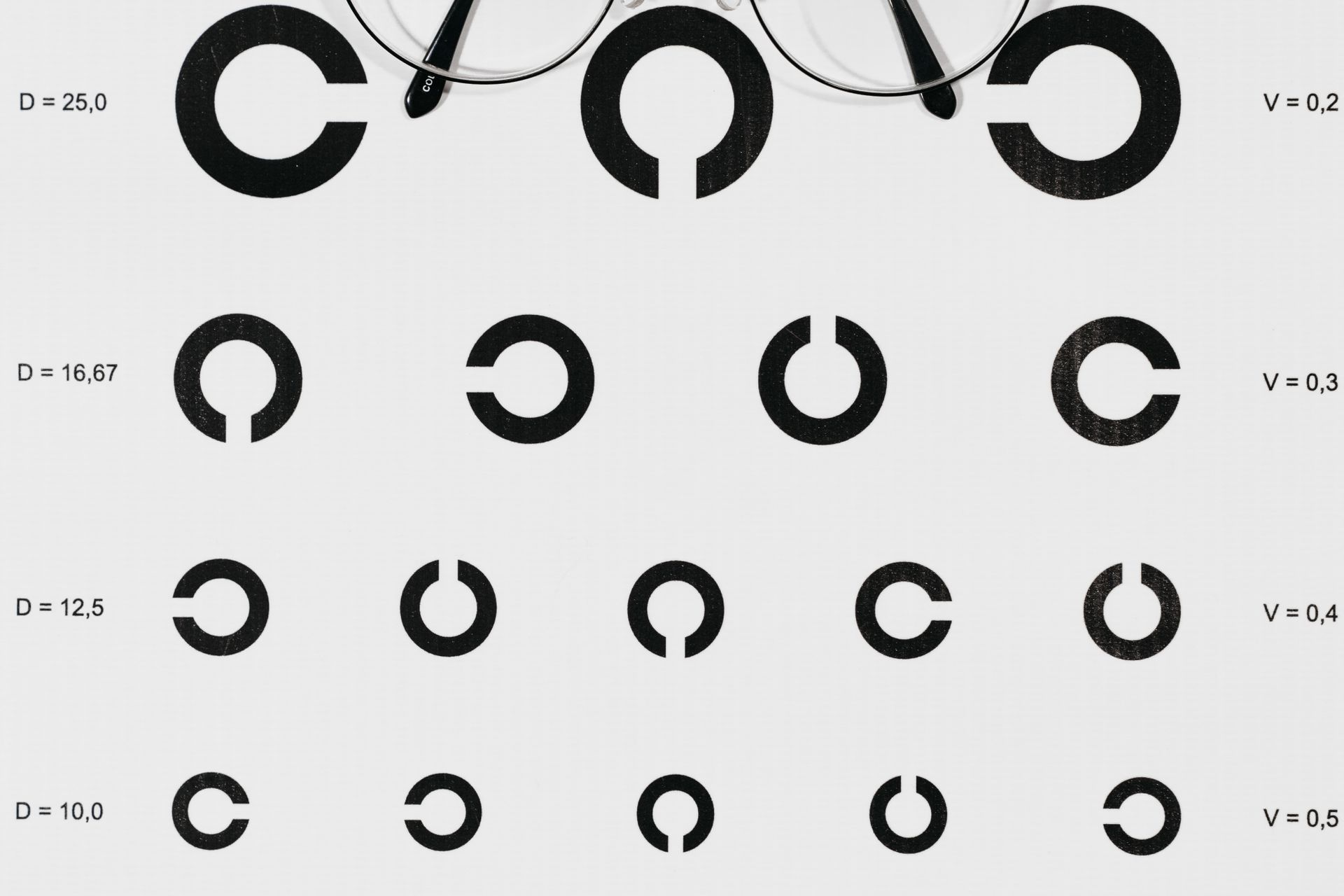
The test itself follows a fixed procedure that is the same at every optician in Germany. First, the optician checks your identity and asks whether you wear glasses or contact lenses, because the test is carried out with the visual aid you normally use for driving. You will then sit or stand at a fixed distance from an eye chart or a testing device, and you will be asked to read letters, numbers or symbols in rows that get smaller and smaller. The classic version uses Landolt rings, which are circles with a small opening on one side, and you have to say in which direction the opening points.
The test is done in three rounds: first the right eye alone, then the left eye alone, and finally both eyes together. Each eye is covered in turn, so the examiner can tell how well each eye sees on its own. The whole appointment takes about ten minutes from start to finish, and the result is available immediately. If your vision meets the requirement, you receive the official certificate on the spot. You can read more about the exact sequence in our guide to the eye test procedure, where we describe each round in detail.
The visual acuity requirement: what 0.7 means
The most important number in the whole test is 0.7. For a Class B licence, your better eye has to reach a visual acuity of at least 0.7, while the weaker eye must reach at least 0.1. Visual acuity, also called visus, describes how sharply you can see details at a distance. A value of 1.0 corresponds to normal vision, and 0.7 means that you can still recognise at seven metres what a person with normal vision sees at ten metres. That is enough to read road signs, see other road users and react in time, which is what the test is really about.
It is worth knowing that the 0.7 limit applies to your vision with your usual visual aid. If you wear glasses or contact lenses, you take the test with them on, and your corrected vision is what counts. Many people who are not sure about their eyesight are surprised to learn that they pass easily once their glasses are on. If you have never had your eyes tested before, it can help to have a quick check at an optician before the official test, so that you know where you stand and can get glasses in time if you need them.
What the eye test costs in 2026
The price of the eye test is capped by law in Germany. Opticians may charge a maximum of 6.43 euros plus VAT for the official test, which works out at about 7.65 euros including tax. In practice, many opticians ask for a flat rate of around ten euros, and some offer the test for free if you buy glasses from them. Either way, it is one of the cheapest steps on the way to your driving licence, and it is worth paying for, because the certificate you receive is valid for two years.
The price is lower than the cost of a full eye examination at an ophthalmologist, which usually costs between 30 and 100 euros and takes much longer. That is because the ophthalmologist does a detailed medical check of your eyes, while the optician only carries out the standardised test required for the licence. For an overview of all the costs involved, see our guide to eye test costs, which lists the current prices for opticians and ophthalmologists in detail.
With glasses or contact lenses: what counts
If you already wear glasses, you should always bring them to the test and wear them during the examination. The same applies to contact lenses. The examiner will note on the certificate whether a visual aid is needed, and if the result depends on it, the driving licence will carry the code number 01, which means that you are only allowed to drive with a visual aid. That entry is not a punishment, and it does not limit you in any other way. It simply records what you need to see well enough to drive safely.
One practical tip is to make sure that your glasses are up to date before the test. If your prescription is several years old, your vision may have changed, and an old pair of glasses might no longer be strong enough to reach 0.7. A quick check at the optician beforehand can save you a failed test and a second appointment. Contact lens wearers should bring their lens case and a pair of glasses as a backup, in case a lens causes problems on the day.
How long the certificate is valid
The eye test certificate for a Class B licence is valid for two years from the date of the test. That is normally more than enough time to finish your driving lessons and pass the practical test, but it is worth keeping the deadline in mind. If your training takes longer than expected, for example because you take a break for a few months, the certificate can expire, and you will have to take the test again. The repeat test costs the same as the first one, and it follows exactly the same procedure.
Keep the certificate in a safe place together with your other driving licence documents, and make a copy or a photo of it for your own records. If you lose it, the optician who carried out the test can usually issue a replacement, as long as the certificate is still within its period of validity. After the two years have passed, a replacement is no longer possible, and a new test is the only option. Plan your driving lessons with this in mind, and hand in your application soon after the test.
What to do if you do not pass
Failing the eye test is not the end of your driving licence plans. The most common reason is that the vision is simply not sharp enough, either because the glasses are too weak or because no visual aid has been used at all. In that case, the first step is to have your eyes checked properly and to get the right glasses or contact lenses. Once you have the correct prescription, you can take the test again, and most people pass it on the second attempt without any difficulty.
If even a perfect correction does not bring your visual acuity up to 0.7, the situation is different. For Class B, the law allows a medical assessment in some cases, but the requirements are strict, and a specialist report from an ophthalmologist is needed. Discuss the situation openly with your optician and with your doctor, and ask the driving licence authority what evidence is required. The important thing is not to give up too quickly, because many cases that look hopeless at first can be solved with the right correction.
What the eye test certificate contains
When you pass the eye test, the optician hands you a certificate that confirms your visual acuity. The certificate is a single sheet of paper, and it contains your full name and your date of birth, so that the driving licence authority can match it to your application. It also states the date of the test, the name and address of the optician or ophthalmologist who carried out the test, and the result of your visual acuity in each eye, usually as a visus value such as 0.7, 0.8 or 1.0. If you wear glasses or contact lenses, the certificate notes that you need a visual aid, and the code number 01 is recorded for your driving licence. The certificate is stamped and signed by the optician, which makes it an official document that the driving licence authority accepts without any further proof.
Before you leave the shop, check that all the details on the certificate are correct, especially the spelling of your name and your date of birth, because a mistake can cause problems when you hand in your application. The certificate does not contain a result for colour vision, because colour vision is not part of the standard eye test for a Class B licence, and it does not contain a medical diagnosis or a prescription for glasses. It is only a confirmation that your visual acuity meets the legal minimum on the day of the test. Keep the original in a safe place, because you need it when you hand in your driving licence application, and a copy or a photo is not enough for most authorities. If the certificate is older than two years when you apply, it is no longer valid, and you have to take the test again. The certificate is only for the driving licence, so it does not replace a medical report if you apply for a lorry or bus licence, where a full medical assessment is required instead.
Conclusion
The driving licence eye test for Class B is a quick, cheap and straightforward step on the way to your licence. It takes about ten minutes, costs less than ten euros, and the visual acuity limit of 0.7 is easy to reach for most people, especially with glasses or contact lenses. The best way to prepare is to book the test in good time, take your visual aid with you, and make sure that your glasses are up to date. If you follow these simple tips, there is very little that can go wrong, and you will have the certificate in your hand before you know it. Once that is sorted, you can focus on what really matters: learning to drive.
Frequently asked questions
Do I have to take the eye test before my theory lessons?
No, you can start your theory lessons at any time, but you need the eye test certificate before the driving licence authority will accept your application, so it is best to do the test early and not leave it to the last minute.
How much does the eye test for Class B cost?
By law, opticians may charge a maximum of 6.43 euros plus VAT, which is about 7.65 euros in total. Many opticians ask for a flat rate of around ten euros, and some offer the test free of charge if you buy glasses there.
Can I take the test with glasses or contact lenses?
Yes, and you should. The test is carried out with the visual aid you normally use for driving, and the corrected vision is what counts towards the 0.7 requirement. If you need a visual aid, the code number 01 is entered in your licence.
How long is the eye test certificate valid?
The certificate is valid for two years from the date of the test. If it expires before you have finished your driving test, you have to take the eye test again.
Where can I take the eye test?
At almost any optician in Germany, without a long wait and usually without an appointment. The test is standardised, so the certificate is accepted by every driving licence authority in the country.
What happens if I fail the eye test?
In most cases, a new pair of glasses or contact lenses is enough. Once you have the right correction, you can repeat the test. Only if the required visual acuity cannot be reached even with correction is a medical assessment needed.
Do I need to bring anything to the eye test for Class B?
Bring your identity card or passport, your glasses or contact lenses, and your appointment confirmation if you booked a slot. The optician needs your personal details for the certificate, and the test is done with the visual aid you normally use. You do not need a form from the driving school. A recent glasses prescription can be useful but is not required.
How long does the eye test for Class B take in total?
The test itself takes five to ten minutes. With registration and the certificate, the whole visit usually takes fifteen to twenty minutes. You can often walk in without an appointment, and many opticians offer the test during normal opening hours. If you also need new glasses, the visit takes longer, so mention this when you arrive.