Can You Improve Your Vision Before the Eye Test?

Can you improve your vision before the eye test? It is one of the most hopeful questions a driver can ask, and the honest answer is both encouraging and limited. Yes, you can improve the result you get on the day, and the improvement can be more than a line on the chart, but no, you cannot change the basic shape of your eye or cure a refractive error in a week. The difference between those two statements is the difference between a useful week of preparation and a week of false promises, and this guide explains it in plain terms, with sleep, diet and realistic expectations at the centre.
What follows is not a training programme and not a set of eye drills. It is a look at what actually affects your vision in the days before a test: how much sleep you get, what you eat and drink, how tired and dry your eyes are, and the state of your general health. You will also learn what does not work, from the famous carrots myth to the eye exercise programmes that promise to throw away your glasses, and why the most reliable improvement of all is still a correct pair of glasses or contact lenses. Read it before you book, and you will know what is worth doing, what is harmless, and what is a waste of money.
The honest answer in one minute
Your vision depends on the shape of your eyeball, the curve of your cornea and the lens inside your eye, and none of those change because you eat well for a week. If you are short-sighted, your eyeball is slightly too long, and light focuses in front of the retina; if you are long-sighted, it focuses behind it. No food, no exercise and no supplement can shorten or lengthen the eyeball, and that is why no reputable ophthalmologist promises to improve a refractive error with lifestyle changes. What lifestyle can change is the quality of the image the eye produces on the day: a rested, well-hydrated eye with a healthy tear film focuses better than a tired, dry one, and the difference is real, measurable and sometimes decisive.
That is the level at which this article works. A well-rested person can read a line or two better than a tired one, a person whose eyes are not dry can see the rings more clearly, and a person who is not ill and not on medication that blurs vision will get the result that reflects their true eyesight. The test itself is also sensitive to timing: a morning appointment after a good night of sleep gives a better result than a late appointment after a ten-hour screen day. Those are the improvements that are available to everyone, and they are worth taking, even though they will not turn a person with a real refractive error into a person without one.
Sleep: the biggest short-term factor
Sleep is the most powerful short-term lever you have. During sleep, your eyes recover from the day, the tear film is refreshed, and the muscles that focus the lens relax. After a short night, those muscles are tired, the tear film is thin, and the image on the retina is slightly less sharp. Studies of visual performance show that sleep deprivation makes the eyes slower to focus and less able to sustain a clear image, and anyone who has tried to read a sign after a night with too little sleep will recognise the feeling. The effect is larger than most people expect: a bad night can cost a line on the chart, and for a driver close to the limit, that line is the test.
The practical advice is simple and cheap. For the two or three nights before the test, sleep your normal amount, seven to eight hours for most adults, and keep your usual rhythm rather than trying to catch up in one long sleep on the night before. Go to bed at the time you normally do, put your phone away an hour before bed so that the screen does not keep you awake, and avoid alcohol in the evening, because alcohol disturbs sleep and dries the eyes. If you take the test in the morning, give yourself time to wake up properly: an eye test taken five minutes after getting out of bed is not the same as one taken two hours later, because the eyes need time to adapt to being awake. Book the test for mid-morning if you can.
Diet and nutrients for eye health
Food matters for your eyes, but slowly. The nutrients that support vision are well known: lutein and zeaxanthin, which are found in green leafy vegetables such as spinach and kale, protect the retina; vitamin A, found in carrots, sweet potatoes and eggs, supports the light-sensitive cells; omega-3 fatty acids from oily fish help keep the tear film healthy; and vitamin C and zinc support the eye as a whole. A diet rich in these foods is good for your eyes over years, and it is especially good for reducing the risk of age-related conditions such as macular degeneration. What it will not do is sharpen your vision in a week.
That distinction is important, because the food and supplement industry often blurs it. Blueberry capsules, carrot juice, bilberry extract and eye vitamins are sold with the promise of better vision, and there is little good evidence that they improve visual acuity in healthy people over days or weeks. If your diet is poor, improving it will help your health in general, and your eyes will benefit too, but the benefit is measured in years, not in lines on a chart. Eat well in the week before the test because it is good for you, drink enough water so that your tear film stays healthy, and be sceptical of any product that promises a fast result. The same goes for vitamin supplements: if a doctor has not prescribed them, they are very unlikely to change your test result. The driving licence eye test procedure is a measurement of your eyes as they are, and a healthy diet is the best long-term way to keep them that way.
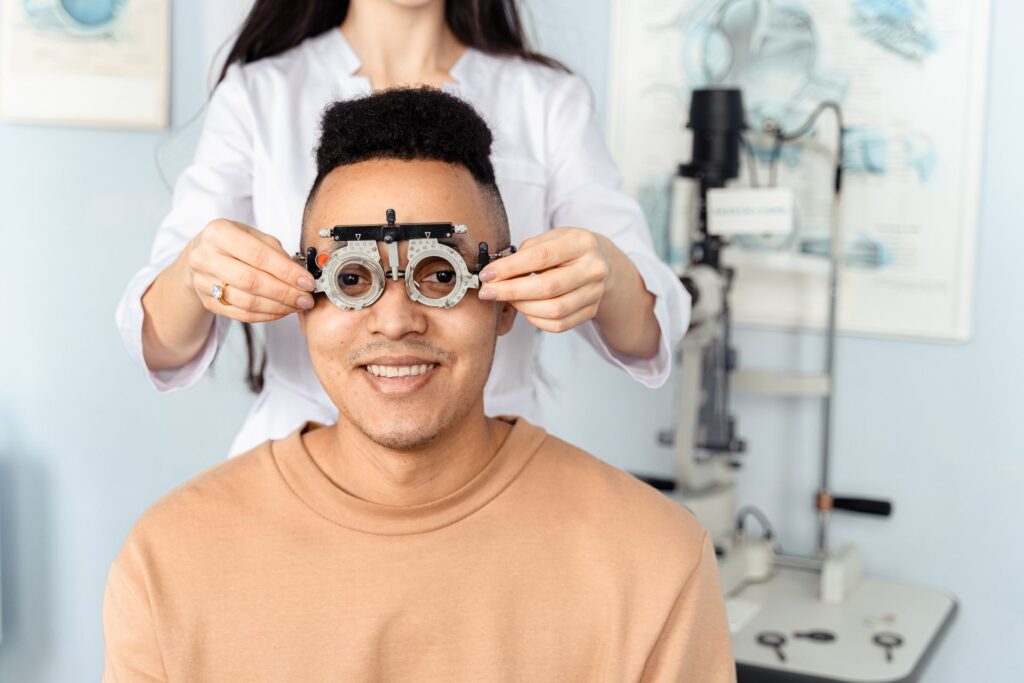
Screen habits, blinking and dry eyes
In the week before the test, your screen habits matter more than your diet. When you stare at a screen, you blink much less often, about a third as often as usual, and less blinking means a thinner tear film and a drier eye. Dry eyes make the vision waver, especially in the evening, and the chart can seem to blur and clear as you blink. The remedy is not complicated: follow the twenty-twenty-twenty rule, every twenty minutes look at something twenty feet away for twenty seconds, and make a conscious effort to blink fully when you use a screen. It sounds trivial, but after a few days of doing it your eyes feel less tired, and the difference on the test day is real.
Also consider the environment. A dry, air-conditioned office, a car with the heating blowing on your face, or a room with a ceiling fan can all dry the eyes, and the effect is worse if you wear contact lenses. Using lubricating eye drops a few times a day in the week before the test can help, and many opticians recommend preservative-free drops because they can be used often without irritating the eye. Do not use whitening drops that promise to make the eyes look less red: they do not improve vision, and they can leave the eye irritated. If your eyes are persistently dry or painful, see an eye doctor, because there may be a condition such as dry eye disease that needs treatment rather than drops.
What does not work: myths and quick fixes
The internet is full of methods that promise to improve your vision quickly, and most of them do not work. Eye exercises, such as rolling the eyes in circles, shifting focus between a near and a far object, or staring at the sun, are often sold as a way to strengthen the eye muscles and improve vision. The muscles that focus the lens do work when you change focus, but exercising them does not change the shape of the eye, and there is no good evidence that eye exercises improve visual acuity in people with a refractive error. That is not to say that focusing exercises are harmful: they are usually harmless, and taking breaks to look into the distance is good for tired eyes, but they are relaxation, not treatment.
Other popular fixes are equally unproven. The idea that eating carrots gives you excellent vision comes from a wartime story and has almost no truth in it: vitamin A helps night vision if you are deficient in it, but extra carrots do not give you better vision than a person who eats normally. Pinhole glasses, which are glasses with tiny holes instead of lenses, do make the image look sharper for a moment, but they only work while you are wearing them and they reduce the amount of light reaching the eye, so they are not a way to pass a test or to drive. The same applies to eye drops that promise to shrink the pupil: they can improve depth of focus briefly, but they do not change your refractive error, they can be dangerous, and an optician will notice them. If a product promises a fast improvement in vision, treat the promise with suspicion and check it with an eye doctor before you spend money on it.
When the answer is glasses, not willpower
For many people, the honest answer to the question of whether they can improve their vision before the eye test is that they cannot, and that the right move is to accept that. If your distance vision has been getting weaker, if road signs are harder to read than they were a year ago, or if a previous test was close to the limit, the improvement you need is a correct pair of glasses or contact lenses, not a week of healthy living. Book an eye measurement with an optician, get the prescription, and take the test with the correction you will drive with. That is the improvement that actually works, and it can be arranged in a few days. You can find a fuller explanation of how a weak eye is treated in our article on one eye being weaker than the other.
There is also a point at which a doctor should be involved rather than a lifestyle change. If your vision has changed suddenly, if you see flashes or floaters, if one eye has become much worse than the other, or if your vision is blurred in a way that does not clear when you blink, see an ophthalmologist rather than waiting for the test. Those symptoms can be signs of a condition that needs treatment, such as a detached retina or an infection, and early treatment is what protects your vision in the long term. In that situation the eye test is not the priority: your sight is. Once the doctor has treated the problem, the eye test follows in its own good time.
Improve your vision before the eye test: what actually works
If you want to give your eyes the best chance before the eye test, the honest list of things that work is short, and it is worth knowing what is on it and what is not. Sleep is first: a full night of sleep, seven to eight hours, leaves the eyes rested and the focusing muscles relaxed, and a tired eye scores worse on the chart than a rested one, even when the prescription is the same. Water is second: a dehydrated eye is a dry eye, and a dry eye blurs the rings, so drink normally on the day and do not arrive after hours without a drink. And rest from screens is third: an hour away from the phone and the laptop before the test lets the eyes relax, and that is a real, measurable difference, even if it is a small one.
The list of things that do not work is longer, and it is worth being honest about it. Eye exercises, whether they are the Bates method or a phone app, do not change the shape of the eye, and they do not improve the refractive error that the test measures. Supplements and special foods contain nutrients that are good for general eye health, such as the lutein in leafy greens, but they do not change your visual acuity in a week, and no vitamin will move your score on the chart. If your vision is below the standard, the only thing that will move it is the right correction, and the best preparation is the honest one: sleep well, arrive rested, and get the glasses measured properly.
Frequently Asked Questions
Can I improve my vision in one week before the eye test? You can improve the result by sleeping well, resting your eyes and avoiding dryness, often by a line on the chart. You cannot change a refractive error in a week, so if you need glasses, get them measured and take the test with them.
Do carrots improve your eyesight? Only if you are deficient in vitamin A, which is rare. Carrots are healthy and vitamin A supports night vision, but eating extra carrots will not raise your score on the eye chart.
Do eye exercises work? There is no good evidence that eye exercises improve visual acuity in people with a refractive error. Looking into the distance and blinking during screen work helps tired eyes, but it is rest, not treatment.
Should I take the test in the morning? Yes, if you can. Your eyes are rested in the morning and your vision is more stable, while a late appointment after a long screen day can make the result a line worse.
Conclusion
So, can you improve your vision before the eye test? In the ways that matter on the day, yes: sleep well for a few nights, give your eyes regular breaks from screens, keep them moist, and book a morning appointment. That is a real improvement, and it costs nothing. In the way that the adverts promise, no: no food, no exercise and no supplement will change the shape of your eye, and no one should spend money on a promise that no eye doctor would make.
The honest preparation is a mix of both: do the easy things that help on the day, and be realistic about the rest. If you need glasses, get them, wear them, and take the test with them, because that is the improvement that lasts. Your eyes will show their best on the day if they are rested, healthy and properly corrected, and that is everything a fair test can ask of them.