Eye Test for People with Astigmatism

Introduction
Eye test for people with astigmatism is a topic that worries many drivers, because astigmatism sounds complicated and many people think that it will stop them from getting a driving licence in Germany. It will not. Astigmatism is one of the most common eye conditions in the world, and most people with astigmatism drive every day, with glasses or contact lenses, and pass the eye test without any problem. This guide explains what astigmatism is, how the eye test for people with astigmatism works, what the values on your prescription mean, and how to pass the test the first time.
Eye test for people with astigmatism starts in the same way as the standard German driving licence eye test: you go to an optician, read letters from an eye chart, and the optician writes your visual acuity on the official certificate. The difference is that the optician will also check the shape of your cornea, the clear front part of your eye, and will test different lens strengths to find the one that corrects your astigmatism. That takes a few minutes longer than a simple test, but it is nothing to worry about, and it is the reason why so many people with astigmatism pass the test at the first attempt.
In this article, you will learn what astigmatism is and why it happens, how it affects your vision at day and at night, how the German eye test works for people with astigmatism, what cylinder and axis mean on your prescription, which glasses and contact lenses work best, and what happens if you fail the test. You will also find practical tips for the test day, and answers to the questions that expats ask most often about astigmatism and driving in Germany. By the end, you will know that astigmatism is not a barrier to a licence, and you will know how to deal with it.
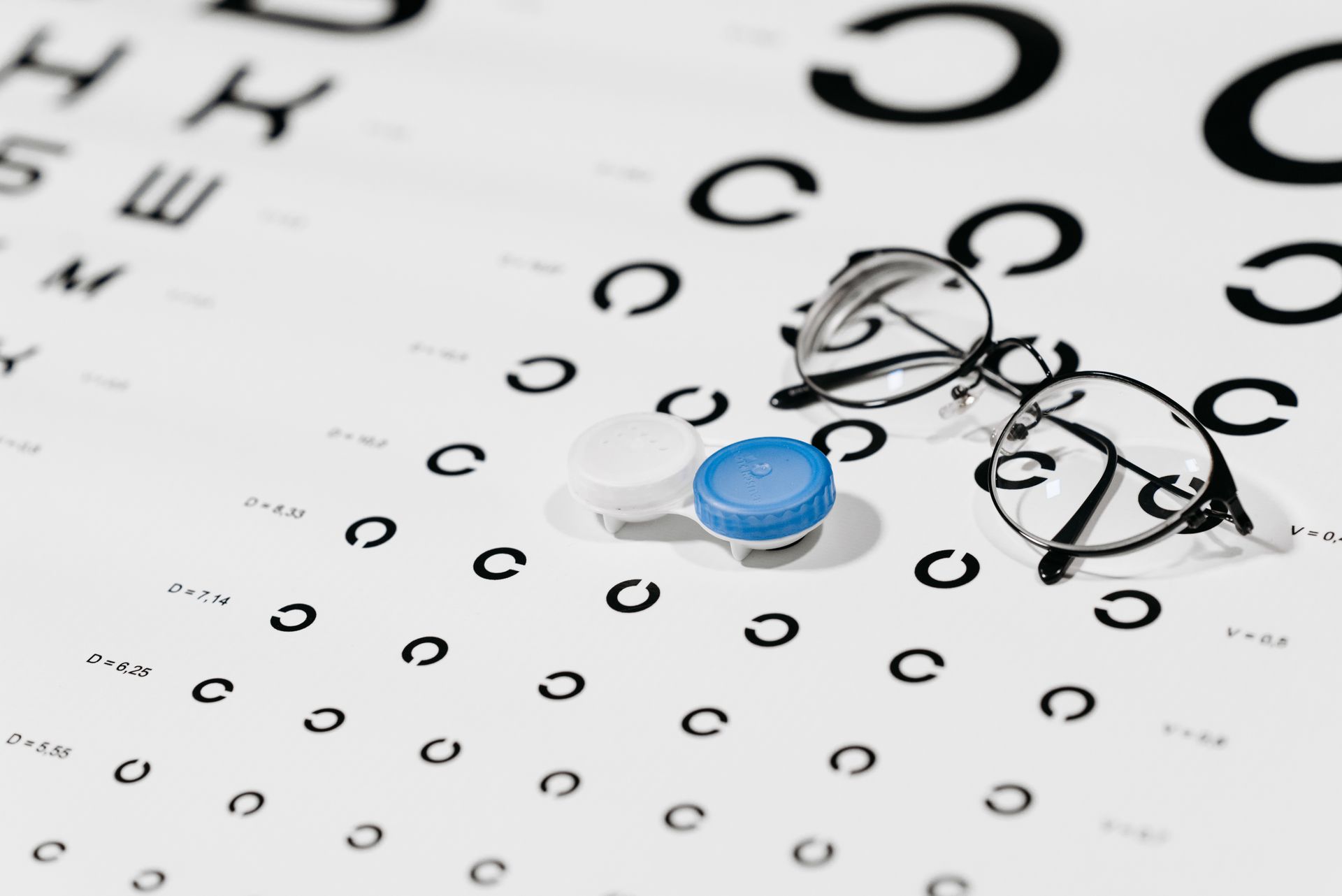
What Is Astigmatism?
Astigmatism is a common refractive error, which means that the eye does not focus light correctly. In a normal eye, the cornea and the lens are round, like a football, and light is focused to a single sharp point on the retina. In an eye with astigmatism, the cornea is more curved in one direction than in the other, like a rugby ball, so light is focused to two different points, and the image is blurred or stretched. A round headlight can look like an oval, a letter can look doubled, and a road sign can be hard to read, especially at night.
Eye test for people with astigmatism is important because astigmatism is often present from birth, and many people do not know that they have it. It can be inherited, and it can change slowly with age, especially after the age of 40. It can also be caused by an eye injury, by surgery, or by a condition called keratoconus, in which the cornea becomes thin and cone-shaped. Most astigmatism is mild, and it is corrected with glasses or contact lenses. Severe astigmatism, above about 3 dioptres of cylinder, needs a more careful correction, and it can make the eye test harder, but it does not usually stop a person from driving.
Astigmatism is not the same as short-sightedness or long-sightedness, although the three often occur together. Short-sightedness means that distant objects are blurry, and long-sightedness means that near objects are harder to see. Astigmatism can affect both near and distant vision, and it can make lights look stretched at any distance. Your glasses prescription will list all three values: the sphere for short- or long-sightedness, the cylinder for astigmatism, and the axis, which is the direction of the astigmatism. Together, they tell the optician exactly which lens you need.
Eye Test for People with Astigmatism: How It Works
Eye test for people with astigmatism begins with the same visual acuity test as the standard Sehtest. You sit at a set distance from an eye chart, and you read the letters or numbers, first with one eye covered, then with the other, and then with both eyes together. The optician records your visual acuity, called Visus, and for a car licence you need at least 0.7 with both eyes together, with or without glasses or contact lenses. If you already wear glasses, the test is done with them on, and the result will show whether they still work or whether you need a new prescription.
Eye test for people with astigmatism then goes one step further. The optician uses a device called a phoropter, or a trial frame with interchangeable lenses, to test different combinations of sphere and cylinder, and to find the axis that gives you the clearest vision. You will be asked to compare two images, or to say which of two lines looks sharper, and the optician will change the lens until your answer is consistent. This is the part of the test that takes the most time, but it is also the most important, because it gives you the prescription that you will need to pass the test and to drive safely.
The optician may also use a machine to measure the shape of your cornea, called a keratometer or a corneal topographer. It shines a ring of light onto your eye and measures how it is reflected, and it produces a map of the cornea that shows exactly how much astigmatism you have and in which direction. This is a painless test, and it takes only a few seconds. The result helps the optician to choose the right contact lens, if you want to wear contact lenses, and it helps the ophthalmologist to check for keratoconus if the astigmatism is unusual or has changed quickly.
The Visual Field Test and Night Vision
Eye test for people with astigmatism also includes a visual field test, which checks how much you can see to the sides. Astigmatism does not usually affect the visual field, but the test is part of the standard eye test, and it must be passed. The optician shows a light or a finger at the edge of your vision, and you say when you first see it. If the field is normal and your visual acuity is at least 0.7, you will pass, and you will receive your eye test certificate.
Night vision is a particular issue for people with astigmatism. At night, the pupil widens, the image becomes less sharp, and an uncorrected astigmatism makes headlights look stretched, doubled, or surrounded by a halo. Many drivers with astigmatism say that they can see well in the day and struggle at night, and that a new pair of glasses with the right cylinder and an anti-reflective coating makes a big difference. If you drive at night, ask your optician for a coating, and ask whether the prescription has been checked for night conditions. Eye test for people with astigmatism is a good moment to raise that point.
Reading Your Prescription: Cylinder and Axis
Eye test for people with astigmatism produces a prescription that lists the sphere, the cylinder, and the axis. The cylinder, written as CYL or Zyl., is the strength of the astigmatism correction, in dioptres. It is usually a minus value, for example minus 1.50 dioptres, and the larger the number, the stronger the astigmatism. A cylinder below 0.50 dioptres is very mild and may not need any correction. A cylinder between 1.00 and 2.00 is moderate, and a cylinder above 3.00 is strong and will need a careful correction and regular checks.
The axis, written as A or Achse, is the direction of the astigmatism, measured in degrees from 0 to 180. The axis tells the optician which way to turn the lens so that the correction is in the right place. A small change in axis can make a big difference: if the axis is wrong by 10 degrees, the lens can make your vision worse instead of better. That is why the optician will test the axis carefully during the eye test for people with astigmatism, and why you should not order glasses online without a proper axis measurement. If your axis changes by more than 10 degrees from one prescription to the next, ask the optician why.
Your prescription will also show the sphere, written as SPH or Sph., which is the correction for short- or long-sightedness. A minus sphere, for example minus 2.00, means short-sightedness, and a plus sphere means long-sightedness. The sphere and cylinder work together, and both are needed to make a lens that corrects your vision. The eye test certificate from the optician page on this site explains the certificate itself, and the eye test for a driving licence page explains how the certificate is used when you apply for your licence.

Glasses and Contact Lenses for Astigmatism
Eye test for people with astigmatism usually results in a prescription for glasses with a cylinder, and that is often all that is needed. Glasses are simple, safe, and easy to adjust, and they can correct even strong astigmatism. An anti-reflective coating is worth the extra cost, because it cuts the reflections that make night driving hard, and it makes the lenses look clearer. A frame that fits well and does not slide down your nose is important, because a lens that slips will move the axis and blur your vision, especially when you turn your head to check a mirror.
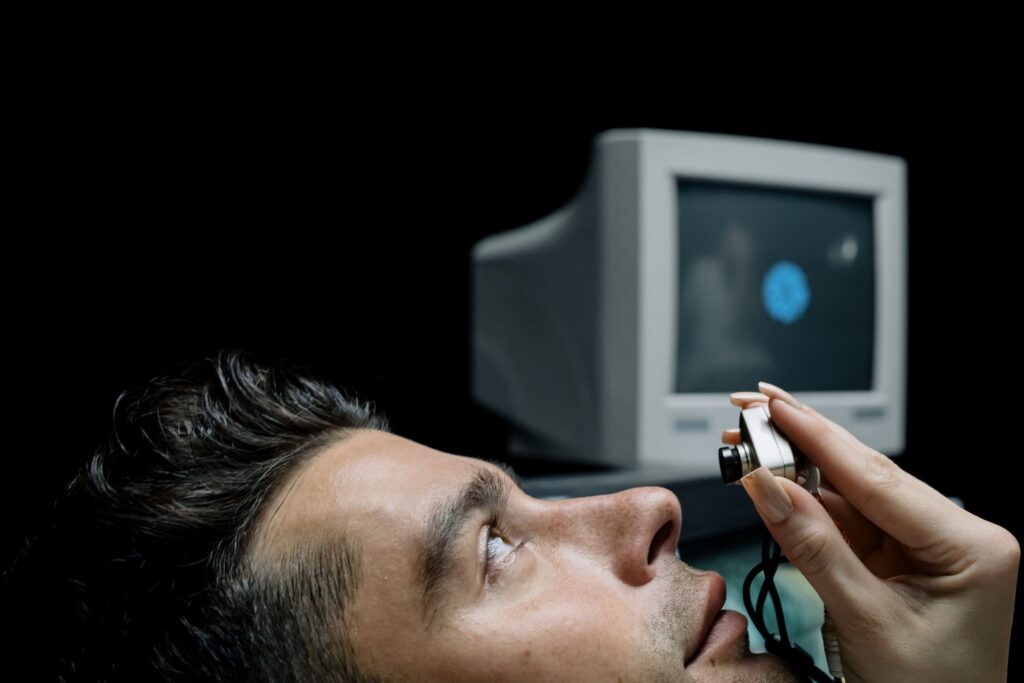
Contact lenses for astigmatism are called toric lenses, and they are designed to stay in the right position on the eye, so that the axis is always correct. A toric lens has a thicker zone that uses gravity to keep it in place, and it is made from a soft material that is comfortable to wear. It can correct astigmatism more precisely than glasses, because it sits directly on the cornea, and many drivers prefer it. But a toric lens can be more expensive than a normal lens, and it may need a fitting appointment with an ophthalmologist or a contact lens specialist, especially if the astigmatism is strong.
Eye test for people with astigmatism is not a one-off check if you wear contact lenses. Your cornea can change shape slightly as you age, and a toric lens that fits well this year may need to be changed next year. Visit your optician at least once a year to have your astigmatism checked, and bring your contact lenses to the test, so that the optician can see whether they are still correct. If you have a problem with dry eyes, which is common in Germany in winter, tell the optician, because a dry eye can make a toric lens uncomfortable and can make your vision appear worse than it is.
What Happens If You Fail the Eye Test
Eye test for people with astigmatism can be failed, and the most common reasons are an outdated prescription, a pair of glasses that no longer corrects the axis, and a test taken when the eyes are tired. If you fail, the optician will tell you your visual acuity and what the problem is. A new pair of glasses with the right cylinder and axis is often enough, and a repeat test a few weeks later will show a better result. You can repeat the test at any optician, and there is no compulsory waiting time. But do not repeat the test until you have the new glasses.
If a new prescription does not raise your visual acuity above 0.7, the optician will refer you to an ophthalmologist. The ophthalmologist will check for keratoconus, a cataract, or a retinal problem, and will write a report if needed. The driving licence office can then decide whether to issue a licence with restrictions, for example a licence that requires you to wear glasses or contact lenses. A restricted licence is a fair outcome, and many drivers in Germany have one. Eye test for people with astigmatism is a test that most drivers pass, and a failure is usually the start of a solution, not the end of driving.
Frequently Asked Questions
Can I get a driving licence in Germany if I have astigmatism?
Yes. Eye test for people with astigmatism is the standard eye test, and most people with astigmatism pass it with glasses or contact lenses. Astigmatism on its own is not a reason to refuse a licence, as long as your visual acuity is at least 0.7.
What do cylinder and axis mean on my prescription?
Cylinder is the strength of the astigmatism correction, in dioptres, and axis is the direction of that correction, in degrees from 0 to 180. Both are needed to make a lens that corrects your astigmatism, and both are measured during the eye test for people with astigmatism.
Are contact lenses better than glasses for astigmatism?
Both work well. Toric contact lenses correct astigmatism precisely because they sit on the cornea, and they are popular with drivers, because they do not fog up and do not slip. Glasses are simpler and cheaper, and they are a good choice if you do not want to wear lenses every day.
Does astigmatism get worse with age?
It can change with age, and it often changes slowly after 40. That is why you should have your eyes checked every one to two years, and why you should not assume that a prescription from five years ago is still correct.
Can laser surgery correct astigmatism?
Yes, in many cases. Laser surgery can correct astigmatism, as well as short- and long-sightedness, but it is not suitable for everyone, and it needs a waiting period before you can apply for a licence. Talk to an ophthalmologist, and check the rules before you book surgery.
For the official legal text behind the rules in this article, see the German driving licence regulation (Fahrerlaubnis-Verordnung).
Eye test for people with astigmatism is a routine test in Germany. Eye test for people with astigmatism is nothing to fear, because most people pass with glasses or lenses. Eye test for people with astigmatism protects you on the road, at day and at night.
Conclusion
Eye test for people with astigmatism is a straightforward test, and it is nothing to fear. Astigmatism means that your cornea is not perfectly round, so light is focused unevenly and images look blurred or stretched. The eye test checks your visual acuity, your visual field, and your cylinder and axis, and the optician finds the lens that corrects your vision. For a car licence, you need a visual acuity of at least 0.7 with both eyes together, with or without glasses or contact lenses. Most people with astigmatism reach that with a new pair of glasses or with toric contact lenses, and many find that night driving becomes much easier. If you fail, a new prescription is often enough. Book your test, bring your current glasses, tell the optician that you have astigmatism, and drive safely in Germany.