How to Choose the Right Optician for Your Eye Test

How to choose the right optician for your eye test is a question that most people only think about after a bad experience, and the choice deserves more attention than it usually gets. The eye test for a driving licence is a simple procedure, but the optician who does it decides whether the certificate is valid, whether the measurement is accurate, and whether problems are found early enough to be fixed. A good optician makes the whole process quick, calm and reliable, while a poor one can cost you a repeat test, a wrong prescription, or a licence application that goes nowhere. This guide explains what to look for, what to pay, and what to avoid.
Below you will find the qualifications that matter, the equipment that a good practice should have, the price you should expect, and the questions to ask before you book. You will also learn the warning signs of a shop that is selling glasses rather than testing eyes, and how to tell the difference between a careful examination and a rushed one. The right choice is usually close to home and easy to make, once you know what matters and what does not.
Why the optician matters
The eye test is only as good as the person who does it. The test itself looks simple, a chart, a few rings, a certificate, but the result depends on the lighting, the distance, the calibration of the equipment and the skill of the examiner. An optician who is in a hurry can miss a small astigmatism, a tired eye can be recorded as a weak one, and a shop that has been in business for twenty years will usually get the same result as the one that has been open for six months, but only if the people who work there take the time to do the test properly. The certificate that the optician issues is the foundation of the licence application, and the driving licence authority will not accept one from a person or a practice that is not authorised to carry out the test.
The optician is also the person who finds problems first. Many people learn that they need glasses, or that one eye is weaker than the other, or that they have a condition worth a doctor’s look, when they sit down for a driving licence eye test. A careful optician will tell you that plainly, will explain the result, and will refer you to an eye doctor when it is needed. A careless one will either miss the problem, or will use it to sell an expensive pair of glasses that you do not yet need. Choosing well is therefore not just about convenience: it is about getting an honest measurement of your eyes at a moment when that measurement matters.
Qualifications: what to look for
In Germany, the eye test for a driving licence can be carried out by an officially recognised assessment body, and in practice it is most often an Augenoptiker, an optician who has completed a recognised apprenticeship, or an ophthalmologist. The title Augenoptikermeister, master optician, means that the person has completed the master craftsman qualification, which is the highest qualification in the profession and a good sign that the practice takes measurement seriously. The central association of opticians in Germany, the Zentralverband der Augenoptiker und Optometristen, known as the ZVA, is the professional body, and many good practices are members, although membership is not a requirement.
What matters more than a title is that the practice is authorised to issue the certificate for the driving licence, that it has been doing so regularly, and that the person who tests you is the person whose name is on the certificate. A chain store on a high street can be just as good as a family business that has been there for forty years, and a small shop can be better than a large one, because the same person tests you and measures your glasses. Ask, in plain language, whether the test includes a measurement of both eyes separately and together, whether the result will be given to you in writing, and whether the certificate is the official form for the driving licence. A good optician will answer these questions without hesitation. Our guide to the eye test at the optician explains what the appointment normally covers.
Equipment and the test itself
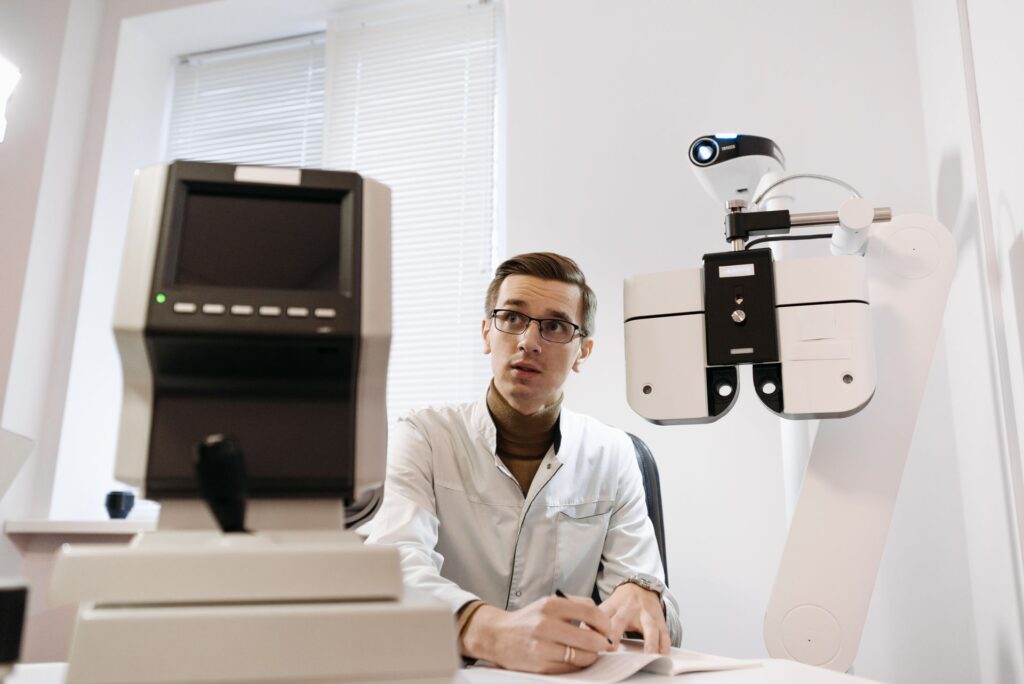
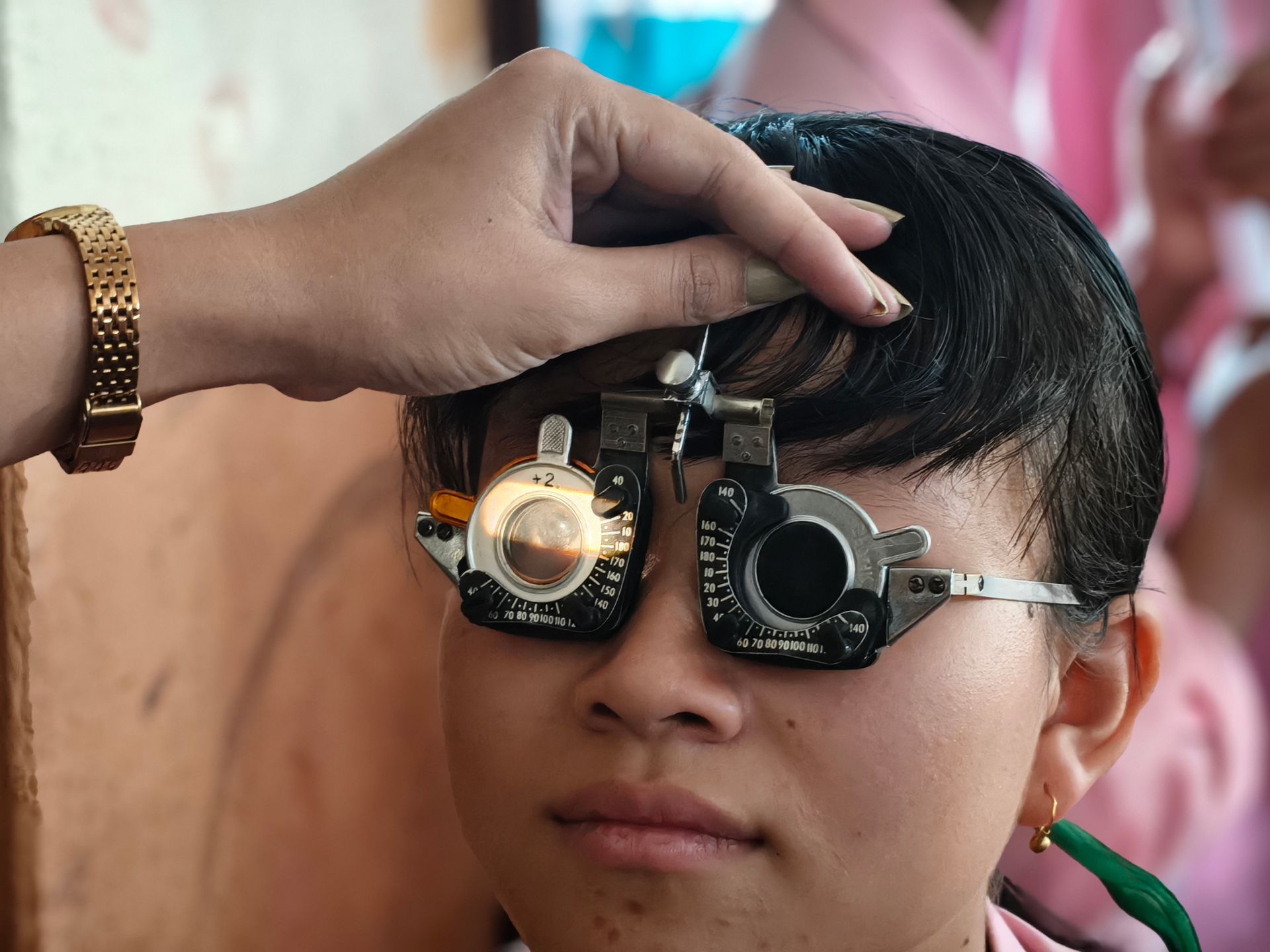
A good practice uses a proper vision testing device or a standardised wall chart at the correct distance, under even lighting, and not a chart that is taped to a door or lit by a desk lamp. The most common devices are the Rodenstock and the Oculus testers, which show the rings and letters in a controlled way, and a professional refractor for measuring the prescription. You can tell a lot about a practice from the room in which the test is done: the chart should be at the distance marked on the floor, the room should be quiet so that you can concentrate, and the optician should be able to explain the result, not only to hand you a piece of paper with a number on it.
The test itself should take a few minutes, usually between five and ten, and it should be done one eye at a time, and then with both eyes together, with your glasses or contact lenses if you use them. The optician should ask about your health, your medication, and whether you have had an eye examination before, because those things can affect the result. If the test is rushed, if you are not asked to cover one eye at a time, or if the optician seems to be guessing at the result, say so, and consider going elsewhere. A careful test costs the practice the same few minutes as a careless one, and the difference is visible in the quality of the result and in how much the optician explains about it.
Price, transparency and hidden costs
The eye test itself is cheap, and any optician who tells you otherwise should be asked to explain. Most opticians in Germany charge between six and fifteen euros for the driving licence eye test, and many charge nothing if you buy glasses from them, which is a normal part of the business rather than a trick. The fee for the test should be stated before the test is started, not mentioned after you have sat down, and if the price is not on the website, ask by phone. A practice that advertises a free test is usually hoping to sell you glasses, and that is fair enough as long as you know it, but a free test that is followed by pressure to buy the most expensive frames is a reason to leave.
The cost of glasses is where the real money is, and it is also where the transparency matters most. A good optician will give you a written estimate with the price of the frames, the lenses, any special coatings and the fitting, before you commit, and will explain the cheaper alternatives without being asked. Our guide to what an eye test costs at the optician lists the typical fees. If you are quoted a price that seems high, ask what is included and whether a simpler lens would do the same job: for a driving licence, the requirement is only that the correction is right, not that it has every available coating. Keep the receipt for everything, because it is the proof of what you paid and what was ordered.
Convenience, reviews and red flags
The practical side matters too. An optician close to your home or your workplace is worth choosing, because you will go back for adjustments, for the retest and for a spare pair, and a shop that is easy to reach is a shop you will actually use. Check the opening hours, and whether you need an appointment or can walk in, because a test that takes a week to book is no use when your application is waiting. Reviews on search engines are worth reading, but read them with sense: a shop with a few hundred reviews and a mixed rating is more informative than a shop with ten perfect reviews, and the pattern in the comments, about friendliness, about waiting times, about aftercare, is more useful than the star count.
There are a few red flags to watch for. If a shop will not tell you the price of the test, will not say which person will do the test, or will not show you the result in writing, choose another. If the first suggestion after a failed test is the most expensive pair of glasses in the shop, without a trial lens or a measurement, be sceptical. And if the shop refuses to issue a certificate unless you buy glasses from it, that is not acceptable: the eye test and the sale of glasses are separate things, and you are free to take the certificate from one shop and the glasses from another. A good optician knows this and is relaxed about it, because the trust it builds is worth more than one sale.
Questions to ask before you book
Before you book, a short phone call can save a wasted visit. Ask whether the practice issues the official eye test certificate for the driving licence, what the test costs, how long the appointment takes, and whether you need to bring anything, such as your glasses and your identity document. Ask whether the test is done by a qualified optician and whether the certificate is issued on the same day. Ask what happens if the test is failed, whether a retest is included in the price, and how long new glasses would take if you need them. A good practice will answer these directly and without being defensive, and the answers will tell you most of what you need to know.
On the day, two more things are worth remembering. Bring your current glasses and your identity document, and arrive a few minutes early so that you are not rushed. If the optician is friendly, explains the result, and answers your questions, you have found the right practice, and you can keep going there for the next measurement in two years. If the experience is rushed or pressured, choose another practice next time: your eyes are worth the small effort of finding a practice you can trust, and the right one is rarely far away.
Choose the right optician for your eye test: questions that reveal the truth
The questions you ask before you book are often more revealing than the answers you get to them. Ask who will do the test, and whether that person is a qualified optician or an assistant: the answer tells you whether the practice takes the test seriously, because the test is only as good as the person doing it. Ask how long the test takes: a proper test takes a few minutes, but a practice that promises it in sixty seconds is cutting corners, and a practice that takes half an hour may be trying to sell you something. Ask whether the certificate is issued on the same day: a good practice will say yes, and a practice that hesitates is one to avoid.
The answers also tell you about the price, and the price tells you about the practice. A practice that states the fee plainly, before the test, is a practice that has nothing to hide, while a practice that will not say what the test costs is a practice that will probably try to charge more afterwards. Ask what is included in the price, whether a retest is included if the first test fails, and whether there is a separate charge for the measurement if you need new glasses. The answers should be short and clear, and if they are not, that is itself an answer: the practice is not for you, and there is another one nearby.
Finally, ask about aftercare, because a good optician is a relationship, not a transaction. Ask whether the practice adjusts glasses free of charge, whether it will check the fit after a few weeks, and whether it keeps your measurements on file so that the next pair is easier to order. A practice that answers these questions well is one that expects you to come back, and that is exactly what you want: an optician you can trust with your eyes for years, not a shop that sees you once. The eye test is the first step in that relationship, and it is worth choosing the practice as carefully as you would choose a doctor.
Frequently Asked Questions
Does it matter which optician does the eye test? Yes. The optician decides whether the certificate is valid, how accurate the measurement is and whether problems are found early. A careful, qualified optician is worth finding.
How much should the eye test cost? Usually between six and fifteen euros, and often free if you buy glasses there. If the price is not stated before the test, ask, and be wary of a test that is followed by heavy sales pressure.
Can any optician issue the driving licence eye test certificate? The practice must be authorised to carry out the test and issue the official certificate. Ask before you book, and make sure the certificate is issued on the same day.
What if I fail the test there? Ask whether a retest is included in the price, and whether the optician can measure your eyes and order new glasses. If the failure is due to the glasses, a new measurement usually solves it.
Conclusion
Choosing the right optician for your eye test is mostly a matter of asking a few questions and trusting the answers. Look for a qualified person, proper equipment, a clear price and a practice that explains the result, and avoid any shop that hides the price or pressures you to buy. The test takes a few minutes and it costs only a few euros, but the person who does it shapes the whole application, so it is worth the small effort of choosing well.
Book at a practice you can reach easily, arrive prepared, and keep the certificate safe when it is issued. If the experience is good, keep that optician for the next time your eyes need measuring, because a relationship with a practice that knows your eyes is worth more than a one-off bargain that you have to repeat.